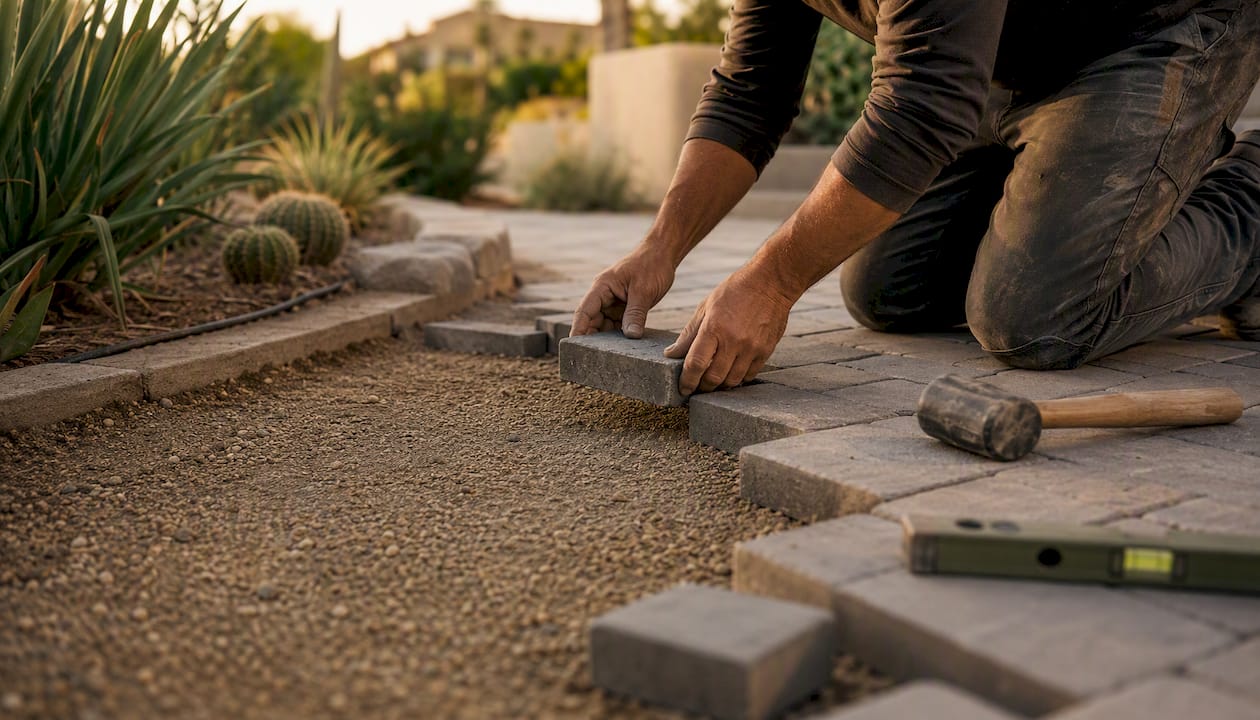
Yes, you can widen a driveway with pavers, and for most homes it beats tearing out concrete. Paver systems are modular, so a widened section can be repaired unit by unit instead of jackhammering a whole slab, and permeable options let water soak through instead of sheeting off into the street.
Before you touch a shovel, do three things. Measure the width you actually need, factoring in whole-paver dimensions so you’re not stuck cutting slivers at the edge. Check your local zoning office or HOA for setback rules and impervious-surface limits, since some municipalities cap how much of a lot can be hard surface. And call 811 (or your regional utility-locate service) to get underground lines marked, because confirming zoning and utility locations before excavation is standard practice for a reason — hitting a gas line with a trencher is not a design choice you get to make twice.
- Measure the target width using whole-paver increments to avoid excessive cutting.
- Contact your zoning or planning department about setback and impervious-coverage limits.
- Call 811 or your local utility-locate line at least a few business days before digging.
- Check your HOA covenant if you have one; some restrict paver color or driveway width outright.
Pro Tip: Call your utility-locate service even if you’re only widening by a few feet. Shallow lines for irrigation, cable, or low-voltage lighting often sit closer to the surface than people assume, and locate services are typically free.
Key Takeaways
Successful driveway widening with pavers depends on correct base depth, verified permits and utility locations, and a drainage plan matched to your climate.
| Point | Details |
|---|---|
| Call before you dig | Confirm permits, HOA rules, and 811 utility locates before any excavation begins. |
| Plan design early | Decide on matching versus contrast, and factor drainage slope into your layout from day one. |
| Base depth drives longevity | Target 6 to 8 inches total depth with proper compaction and edge restraints to prevent shifting. |
| Know your limits | DIY suits flat, simple widenings; complex drainage or grade issues call for a professional like Jackpotlandscape. |
Table of Contents
- Design Ideas for a Widened Paver Driveway
- Do You Need a Permit to Widen Your Driveway?
- How Should You Handle Drainage When Widening a Driveway?
- Which Pavers and Materials Work Best for a Driveway Extension?
- Step-by-Step: Installing Pavers for a Driveway Widening
- How Much Does It Cost to Widen a Driveway With Pavers?
- When Should You Hire a Professional Installer?
- How Do You Maintain a Widened Paver Driveway?
- Real Driveway Widening Projects and What They Reveal
- Is DIY or Hiring a Pro the Smarter Move?
- How Jackpotlandscape Handles Driveway Widening Projects
- Where to Learn More Before You Start
- Frequently Asked Questions
- Sources
Design Ideas for a Widened Paver Driveway
The first design decision is whether to match your existing surface or treat the new section as its own feature. If your current driveway is poured concrete, matching is often impossible without an overlay, so most homeowners either lay pavers only in the new strip for deliberate contrast, or overlay the entire existing surface with pavers for a unified look if the old concrete or asphalt is structurally sound enough to build on. Matching an existing paver driveway is usually easier: identify the manufacturer or product line stamped on the back of a spare paver, or bring a sample to a supplier who carries lines like Unilock, and you can often get a close or exact match.
Layout matters as much as material. A straight strip widening, typically adding multiple feet along one side, is the simplest and cheapest approach. A full-side widening changes the whole driveway’s proportions and works well if you’re also adding a turnaround. Parking pads, set beside or behind the existing driveway, solve the “second car” problem without touching the original surface at all. Curved aprons near the street soften a boxy look and tend to photograph better for curb appeal.
Borders do the heavy lifting when it comes to making an addition look intentional rather than patched on. A soldier course, pavers laid perpendicular to the main field, along the new edge signals a deliberate transition instead of an afterthought. A herringbone pattern in the extension against a running-bond original creates contrast without clashing. A contrasting color band, even just one row, at the seam between old and new draws the eye in a way that looks planned.
Pro Tip: If you can’t match the exact paver, match the joint width and pattern direction instead. A slight color difference reads as intentional; a mismatched laying pattern reads as a mistake.
Do You Need a Permit to Widen Your Driveway?
Almost every jurisdiction has an opinion about driveway width, even if the answer ends up being “no permit needed.” Here’s the order to work through it.
- Call your local planning or zoning office first. Ask specifically about setback requirements, maximum impervious-surface coverage, and whether a curb cut change (if you’re widening near the street) needs its own approval.
- Check your HOA documents if you have one. Some HOAs regulate paver color, pattern, or total driveway width separately from city code, and they can require you to reverse work that technically met city rules.
- Call 811 or your regional utility-locate service before any excavation, full stop. This is free in most of the U.S. and takes a few business days to schedule.
- Confirm the permitting outcome in writing. You’ll typically land in one of three buckets: no permit required for a minor widening, a permit required with an inspection, or approval with conditions (like maintaining a certain drainage slope).
- Gather documentation a contractor or inspector might request: a plot survey or site plan, photos of the existing driveway and utility locations, and any HOA approval letter.
Skipping these steps is how homeowners end up paying to remove a driveway extension that violated a setback they never checked. It’s a fine you pay twice, once for the labor to build it and once for the labor to undo it.
How Should You Handle Drainage When Widening a Driveway?
Drainage decides whether your new pavers last 20 years or start heaving after two winters. Water that pools against a foundation, sheets toward a neighbor’s yard, or saturates the base under vehicle weight is the single biggest cause of paver failure, more than the pavers themselves. A finished slope of about 1 to 2% away from structures is the standard target for solid (non-permeable) paver surfaces.
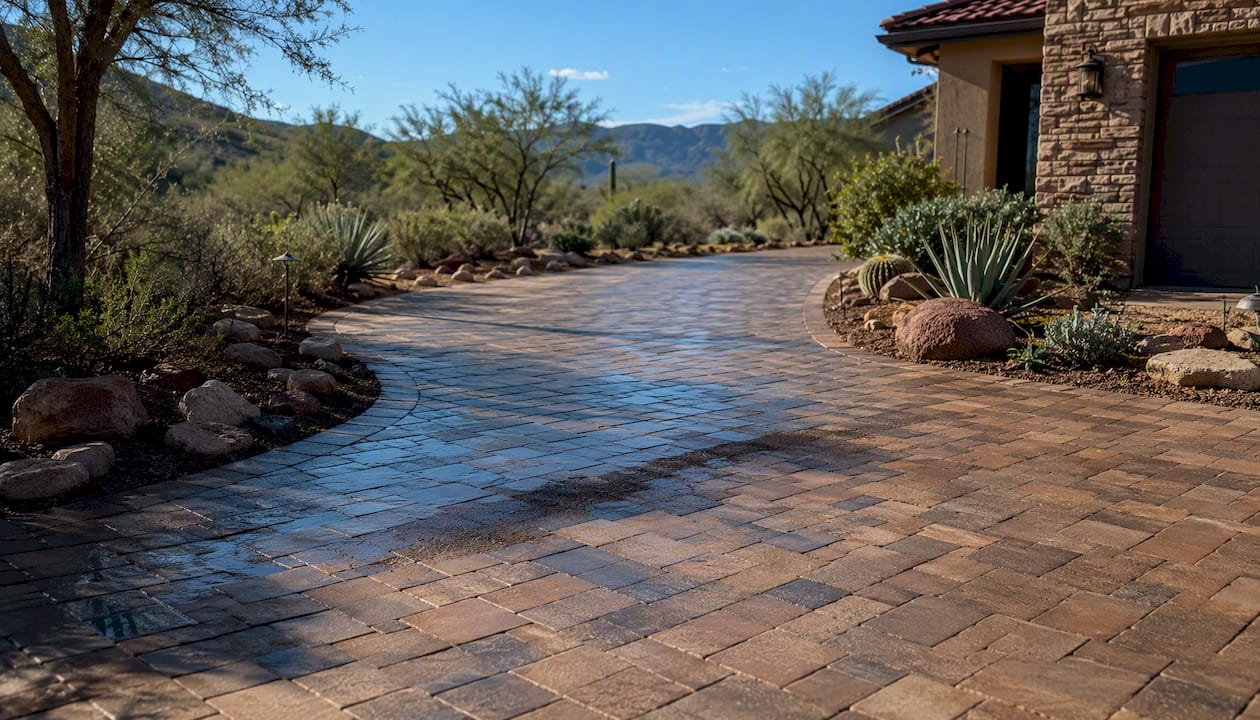
Permeable pavers change the calculus. They make sense when local stormwater rules restrict impervious coverage, when your property sits somewhere that gets frequent heavy rain, or when you’d rather let water infiltrate on-site than route it to a storm drain. Permeable systems manage stormwater differently and can align better with local drainage codes, but they also require a different base design, typically an open-graded aggregate base that lets water pass through rather than a compacted road base that sheds it.
Beyond the paver choice itself, a few drainage tools solve specific problems:
- A French drain along the low edge of the new section handles subsurface water before it reaches the base.
- A linear channel drain across the driveway’s low point catches surface runoff before it crosses into a garage or walkway.
- A vegetated strip or gravel buffer beside the new pavers slows runoff and doubles as a soft transition into a lawn.
Pro Tip: If you’re not sure whether your soil drains well enough for permeable pavers, dig a one-foot test hole and fill it with water. If it hasn’t drained within a few hours, you likely need a French drain or an engineered sub-base rather than relying on infiltration alone.
Which Pavers and Materials Work Best for a Driveway Extension?
Concrete interlocking pavers are the default choice for driveway widenings because they’re rated for vehicle loads, come in dozens of colors and patterns, and are widely available from manufacturers like Unilock. Permeable pavers, a subset of interlocking units with wider joints and open-graded jointing stone, handle stormwater better but usually cost more per square foot and need a deeper aggregate base. Travertine is the premium option: a natural stone with a distinctive matte texture that reads more upscale than concrete, though it typically needs sealing and careful edge restraint in climates with intense UV exposure, since heat and sun accelerate wear on natural stone surfaces over time.
| Material | Best Use | Notes |
|---|---|---|
| Concrete interlocking pavers | Standard driveway widening, parking pads | Widely available, most cost-effective, rated for vehicle loads |
| Permeable pavers | Areas with strict stormwater rules or heavy rain | Requires open-graded base, wider joints, better long-term drainage |
| Travertine | Premium curb appeal, matching upscale hardscape | Natural stone look, benefits from sealing in high-UV climates |
The base underneath matters more than the paver on top. A typical residential driveway build calls for 4 to 6 inches of compacted crushed stone (road base), a layer of geotextile fabric to keep soil from migrating into the stone, and about 1 inch of bedding sand directly under the pavers. Edge restraints, either plastic or aluminum edging staked into the ground, or a concrete curb, keep the whole assembly from spreading sideways under repeated tire loads. Skip them and you’ll see gaps open at the edges within a season or two.
Tools worth having on hand before you start: a plate compactor (rentable by the day), a masonry or diamond-blade saw for cutting pavers to fit, a rubber mallet, a screed board for leveling sand, a 4-foot level, a hand tamper for tight corners, a stiff broom, and eye and respiratory protection for cutting work.
Step-by-Step: Installing Pavers for a Driveway Widening
A motivated homeowner with a free weekend or two can handle a basic side-widening or small parking pad using the same sequence professionals follow, just at a slower pace.
- Measure and mark the extension area with stakes and string, checking that the width works in whole or half pavers to minimize cutting.
- Excavate to your total base depth. A total depth of roughly 6 to 8 inches, including base and bedding, is standard guidance for residential paver driveways, though sandy or unstable soil may need more.
- Lay geotextile fabric across the exposed soil to stop the base material from sinking into the ground over time.
- Spread 4 to 6 inches of crushed road base in lifts, compacting each 2-inch layer with the plate compactor before adding the next.
- Screed 1 inch of bedding sand evenly across the compacted base using a screed board resting on temporary rails.
- Lay the pavers in your chosen pattern, working from a fixed edge outward, tapping each unit into the sand with a rubber mallet.
- Cut border pavers to fit using a masonry or diamond saw, always wearing eye and respiratory protection since cutting produces fine silica dust.
- Sweep polymeric or joint sand into the gaps, then compact the whole surface again to lock the pavers together.
- Seal the surface if desired, particularly for travertine or lighter-colored concrete pavers that show staining more readily.
Paver thickness for driveways typically runs 2.5 to 3.5 inches depending on the product, so factor that into your total excavation depth alongside the base and sand layers.
Pro Tip: Do a dry layout of a few rows before committing to sand and pattern. It takes ten minutes and saves you from discovering halfway through that your pattern doesn’t divide evenly into your width.
How Much Does It Cost to Widen a Driveway With Pavers?
Extension pricing tends to run on a per-square-foot basis similar to a full driveway installation, but your total cost lands lower simply because you’re adding area instead of replacing everything you already have. Side widenings commonly add 4 to 8 feet of width, and parking pads are often a simpler, cheaper alternative to a full-perimeter extension. Exact per-square-foot rates vary widely by region, paver material, and local labor costs, so treat any number you see online as a starting point for a conversation with a local installer rather than a firm quote.
Several factors move the price more than people expect:
- Excavation difficulty: rocky or compacted soil takes longer to remove and disposal costs add up fast.
- Drainage work: adding a French drain or channel drain is a separate line item from the paving itself.
- Material choice: standard concrete pavers cost less than permeable systems or natural stone like travertine.
- Edge restraints: a concrete curb costs more than plastic or aluminum edging but lasts longer under vehicle loads.
- DIY vs. professional labor: labor is often the largest single cost component in a professional quote.
- Permit fees: minor in most cases, but factor them into your budget if your jurisdiction requires one.
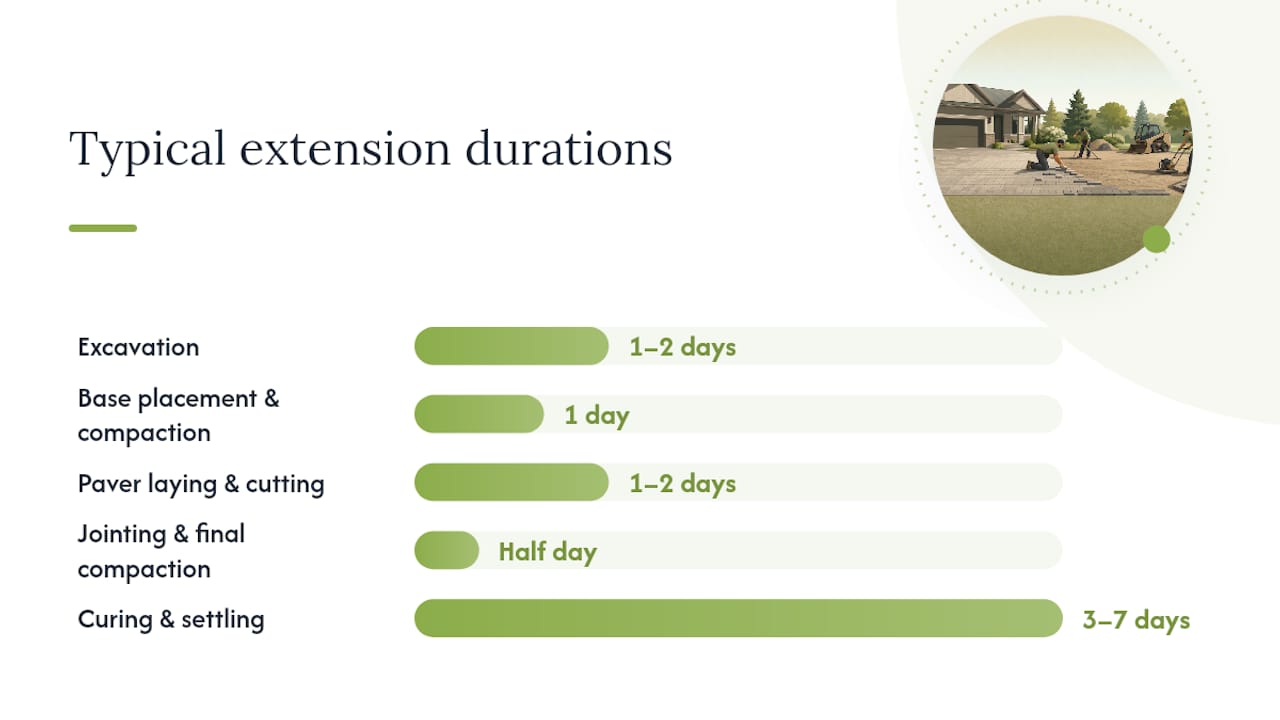
| Timeline Phase | Typical Duration (Small to Medium Extension) |
|---|---|
| Excavation | 1 to 2 days |
| Base placement and compaction | 1 day |
| Paver laying and cutting | 1 to 2 days |
| Jointing and final compaction | Half a day |
| Curing and settling before heavy use | A few days to a week |
If you’re gathering quotes from contractors, ask each one the same set of questions so bids are actually comparable: what base depth they specify, what compaction standard they use, whether they offer a written warranty, and whether they can provide references from a similar recent project.
When Should You Hire a Professional Installer?
DIY works well for a modest widening on flat, stable ground with no drainage complications. Hand the project to a professional when any of the following show up: a significant grade change across the new area, unknown soil or rock conditions that turn excavation into a guessing game, a drainage plan that needs engineering rather than a shovel, HOA or permitting requirements that involve back-and-forth paperwork, or a widening that needs to tie cleanly into existing concrete or asphalt.
A professional buys you more than convenience. An experienced hardscape installer designs the sub-base for your specific soil rather than applying a generic depth, carries a workmanship warranty, handles permit paperwork directly with the municipality, and matches paver color and pattern more precisely because they work with suppliers regularly. That last point matters more than it sounds: a slightly-off match is the difference between a driveway that looks designed and one that looks patched.
Before hiring anyone, ask a few pointed questions: How deep is your standard base for driveway applications? Do you compact in lifts or all at once? What warranty do you offer on labor versus material? Can I see photos or visit a completed project nearby? A contractor who answers those specifics without hesitation, the way Jackpotlandscape’s paver installation projects are documented, is generally a safer bet than one who gives vague reassurances.
Pro Tip: Ask to see a project that’s at least two years old, not just recent work. Fresh installs all look great; the ones that have survived a couple of seasons tell you whether the base was built right.
How Do You Maintain a Widened Paver Driveway?
Routine care is minimal but not optional. Sweep and top up joint sand once a year, since sand naturally works its way out through weather and traffic. Rinse oil or fluid stains promptly with a degreasing cleaner made for hardscape surfaces rather than harsh solvents that can discolor lighter pavers. Inspect edge restraints annually, especially after freeze-thaw cycles or heavy rain, since a loose restraint is usually the first sign of edge spreading.
When something does go wrong, the symptom usually points to the fix. An isolated low spot or a paver that’s settled a half-inch below its neighbors is almost always a homeowner-fixable problem: lift the affected pavers, add or remove bedding sand underneath, and relay them. A widespread sinking area across several feet, on the other hand, usually means the base itself failed, often from inadequate compaction or poor drainage, and that’s a job for a professional who can rebuild the sub-base properly rather than patch the symptom.
Weeds sprouting between joints usually mean the jointing sand has washed out or wasn’t polymeric to begin with; refilling with polymeric sand solves most cases permanently. Reseal or consider replacing individual pavers when color has faded unevenly or when a paver has cracked from a heavy impact. Because paver systems are modular, replacing damaged units doesn’t require touching the surrounding surface, which is one of the real advantages over a poured slab.
Real Driveway Widening Projects and What They Reveal
A backyard renovation in Sahuarita combined turf replacement with paver installation to solve two problems at once: a struggling lawn strip that couldn’t handle Arizona sun, and a driveway that needed more usable parking. Swapping the lawn for artificial turf alongside a new paver section gave the homeowner both extra parking and a lower water bill in one project rather than two separate ones.
A pool deck project in Marana used travertine, the same premium stone worth considering for a driveway extension, to demonstrate how natural stone holds up under direct desert sun when properly sealed and edge-restrained. That project underscores a point worth remembering for driveway work: material choices that perform well on a pool deck in high-UV conditions translate directly to driveway applications facing the same sun exposure.
A Tucson paver patio installation shows the same base-and-compaction principles that apply to driveways, just under foot traffic instead of vehicle loads, and it’s a useful reference if you want to see how a properly built paver surface looks years after installation rather than on install day. Full project photos and details for these and similar jobs are available in the Jackpotlandscape project gallery.
Is DIY or Hiring a Pro the Smarter Move?
DIY makes sense when your extension is small, your ground is flat, and drainage isn’t a fight you need to have with your soil. Hire a pro the moment steep grade, questionable soil, or a permitting maze enters the picture, because the cost of getting the base wrong on a driveway, which carries vehicle weight every single day, is far higher than the cost of getting a patio or walkway wrong.
The real trade-off isn’t money versus effort, it’s how much risk you’re willing to carry on drainage and permitting versus how much you’re willing to pay someone else to carry it for you. Get the base depth and compaction right, confirm your permits before you dig, and the material you choose on top becomes the easy decision.
How Jackpotlandscape Handles Driveway Widening Projects
Jackpotlandscape builds paver driveways for Tucson and Southern Arizona homeowners who’d rather not gamble a multi-day excavation project on trial and error. The advantage over doing it solo comes down to what’s underneath the surface you’ll actually see: an engineered base depth suited to your specific soil, correct compaction at every lift, and edge restraints sized for Arizona’s heat and monsoon swings, not generic online guidance.

Jackpotlandscape’s crews handle interlocking pavers, permeable systems, and natural travertine, along with the drainage planning that keeps a widened driveway from becoming a puddle magnet during summer storms. Every project comes with a clear scope on base specifications and workmanship warranty terms before work starts, so there are no surprises once the compactor shows up. If you’re weighing a driveway widening for your Tucson or Southern Arizona property, request a quote for paver installation and get a firm plan for base depth, drainage, and timeline before you commit to a shovel.
Where to Learn More Before You Start
Regional rules on setbacks, impervious coverage, and permitting vary enough that no single guide covers every jurisdiction, so treat the following as a starting point rather than a final answer for your address.
- Unilock’s driveway widening guide covers permit checks and utility-locate steps in more depth.
- Hunker’s paver extension walkthrough breaks down the base-and-jointing sequence with photos.
- House Digest’s comparison of pavers versus concrete explains the sustainability and repair advantages of modular systems.
- Aspire Pavers’ design style guide offers additional layout and border ideas for blending old and new sections.
- Contact 811 or your local utility-locate service directly to schedule a free line marking before excavation.
- Browse Jackpotlandscape’s project gallery to see finished driveway and paver installations across Tucson and Southern Arizona.
Frequently Asked Questions
Can you really widen an existing driveway with pavers instead of replacing the whole thing? Yes. You only need to excavate and build the new strip, tying it into the existing surface with an edge restraint or border, which is why extension costs typically run lower than full driveway replacement.
What’s the minimum base depth for a paver driveway extension? Most residential applications call for a total depth of roughly 6 to 8 inches, combining compacted crushed stone base with bedding sand, though poor soil conditions may require more.
Do I need a permit to widen my driveway with pavers? It depends on your municipality and whether the widening affects a curb cut or exceeds impervious-surface limits. Check with your local planning or zoning office before starting.
Are permeable pavers worth the extra cost for a driveway widening? They’re worth considering if your area has strict stormwater rules, heavy seasonal rain, or if you want to reduce runoff onto neighboring property; they require a different, open-graded base than standard pavers.
How long does a DIY driveway widening typically take? A basic side-widening or small parking pad often takes a long weekend for excavation and base work, plus another day for laying and jointing, depending on width and soil conditions.
Should I match my existing pavers or go with a contrasting design? Matching looks best when you can identify the original manufacturer or product line; when that’s not possible, a deliberate contrast with a defined border usually looks more intentional than an attempted, imperfect match.
Sources
- How to Widen Your Driveway With Pavers | Unilock
- How To Extend Driveway With Pavers | Hunker
- Skip Pouring New Concrete — There’s An Easier DIY Way To Widen Your Driveway | House Digest
- Extend Your Driveway With Pavers in Jacksonville | Florida Driveway Pavers