Hit 0.50 SCOF: Is Travertine Slippery for Homeowners' Pool Decks?
Hit 0.50 SCOF: Is Travertine Slippery for Homeowners’ Pool Decks?
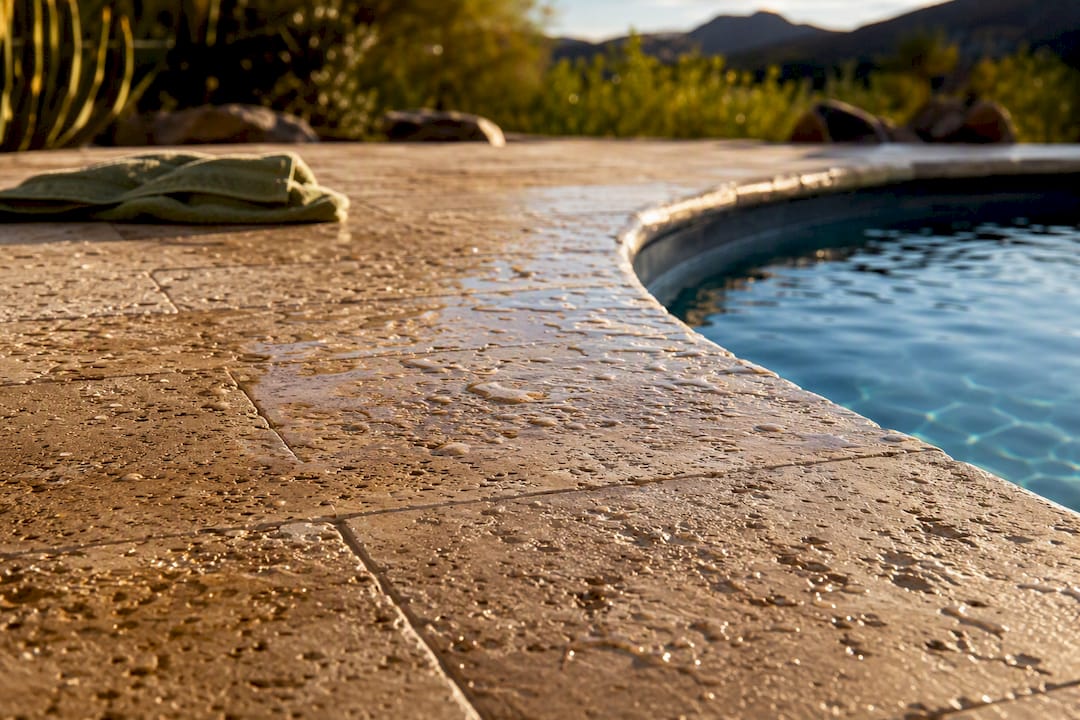
Travertine itself isn’t the problem: it’s neither a naturally slick stone nor a guaranteed non-slip one. Risk depends almost entirely on finish and moisture. Tumbled and brushed finishes tend to maintain grip when wet, while polished and honed surfaces may become slippery around pools and showers. The fixes below cover the finishes, installation choices, and treatments that keep it safe.
TL;DR:
- Tumbled and brushed travertine finishes maintain better slip resistance when wet, with SCOF values often staying above the safe threshold of 0.50.
- Polished and honed surfaces tend to fall below the safe SCOF level once exposed to water, increasing the risk of slips, especially around pools and showers.
- Organic film buildup from soap scum and algae, not the stone itself, often causes slippage issues on previously safe surfaces over time.
- Applying anti-slip treatments or choosing textured installation options can improve traction, but they require periodic reapplication and may alter the stone’s appearance.
- Proper initial finish selection, regular maintenance, and drainage considerations are key to ensuring long-term safety of travertine surfaces.
Table of Contents
- Is Travertine Slippery, and What Actually Controls the Risk?
- SCOF Ranges by Finish: What the Numbers Actually Show
- Why an Existing Travertine Surface Feels Slick
- How to Make Travertine Less Slippery: Treatments and Trade-offs
- Installation Choices That Reduce Slip Risk From Day One
- When Travertine Might Not Be the Right Choice
- Does Footwear Change How Slippery Travertine Feels?
- Keeping Travertine Non-Slippery for the Long Haul
- Travertine Versus Other Flooring: Where It Really Stands
- Jackpot Landscaping’s Perspective From the Field
- Get a Safety-First Travertine Assessment for Your Pool Deck
- Sources
Is Travertine Slippery, and What Actually Controls the Risk?
The number that matters here is the Static Coefficient of Friction, or SCOF. It measures how much resistance a surface offers against sliding, and U.S. guidance commonly treats 0.50 as the minimum safety threshold for pedestrian flooring. Below that number, a surface is considered a slip risk, especially wet.
Water changes the math substantially. A travertine tile that tests fine dry can drop well below that 0.50 line once it’s wet, and pendulum testing under the TS EN 14231 standard found that many travertine finishes land in “high” or “very high” slip-potential categories once soaked. That’s why a showroom sample that feels grippy under your dry hand tells you almost nothing about how it’ll perform at 2 p.m. by the pool.
Finish is the biggest lever you control. Tumbled and brushed surfaces have a textured, matte face that offers better grip. Honed finishes are smoother and fall in between. Polished travertine, with its glassy shine, generally performs worst underfoot when wet.
SCOF Ranges by Finish: What the Numbers Actually Show
Manufacturers and independent testers don’t all agree on exact figures, but the pattern holds across sources. Tumbled and brushed travertine consistently test at the high end, while polished surfaces sit at the bottom, often below the safety floor once wet.
Quick stat: A 0.50 SCOF is the widely cited minimum for safe pedestrian surfaces, but that figure assumes dry conditions. Wet-tested results from pendulum studies show polished and even some honed samples dipping under that mark once soaked, which is exactly the scenario a pool deck lives in every day.
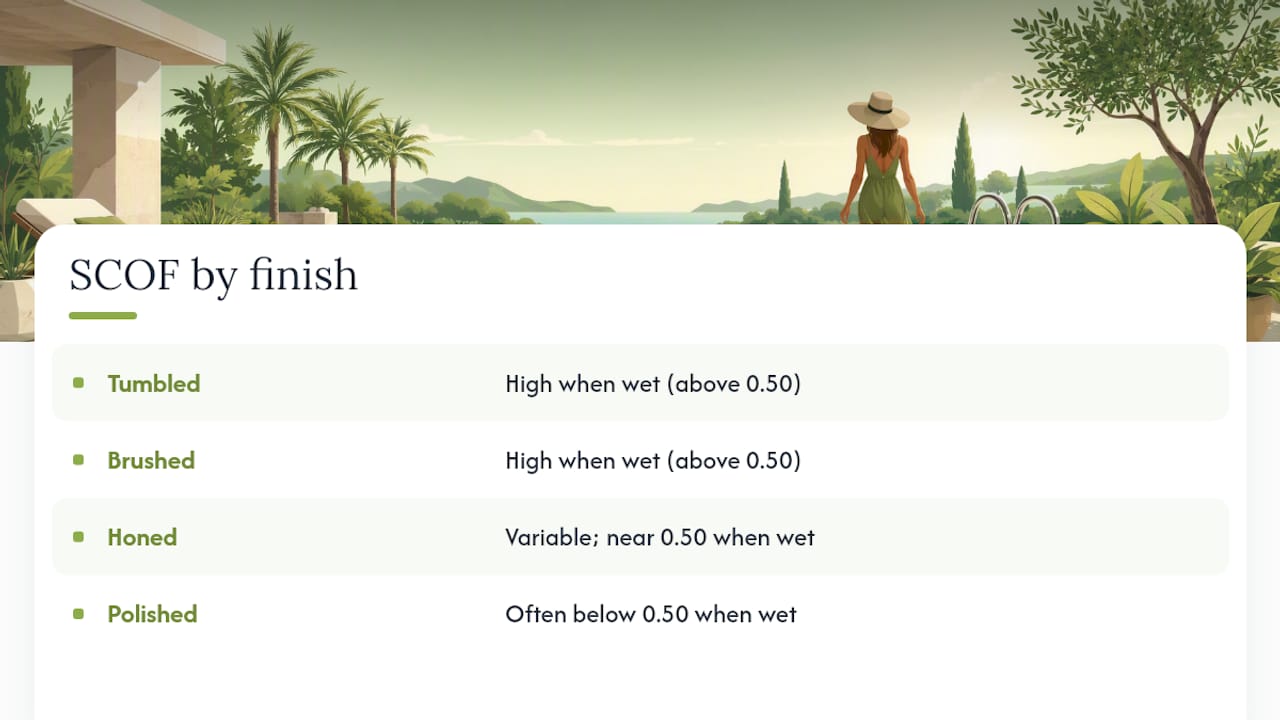
Treat these ranges as guidance, not gospel. Testing methods vary between labs, and even the same quarry can produce slightly different results batch to batch. When in doubt, ask your supplier for the actual test data on the specific slab you’re buying, not just the finish category.
Why an Existing Travertine Surface Feels Slick
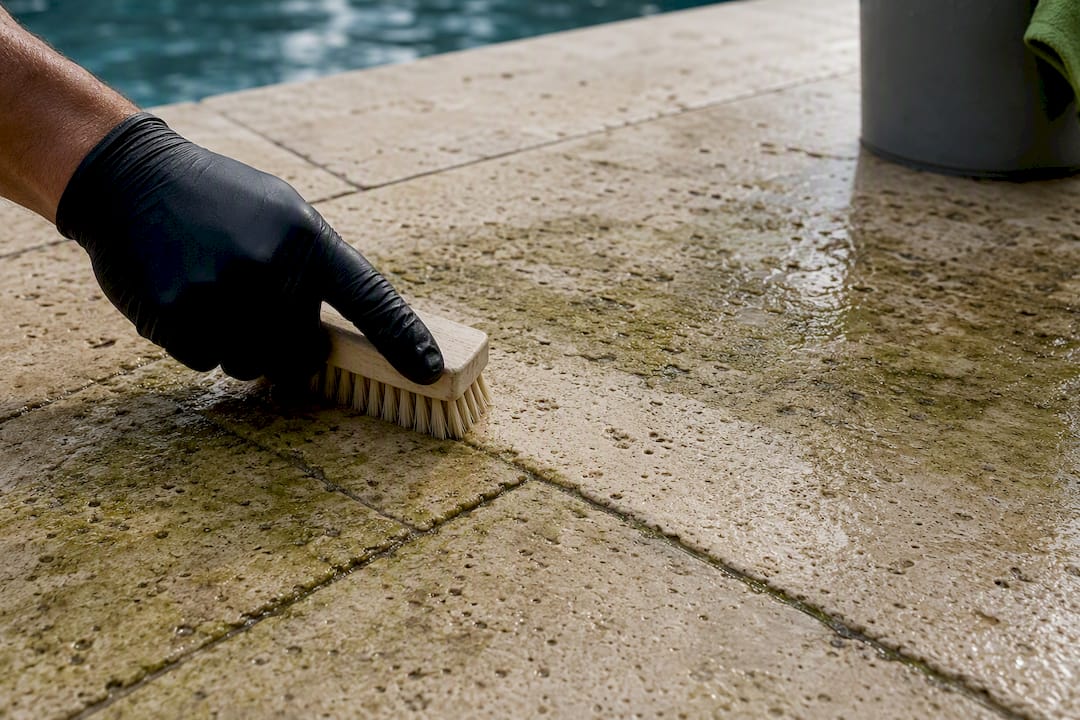
If a deck or shower floor that used to feel fine now feels dangerous, the stone probably isn’t the cause. Soap scum, algae, and general organic film build up on wet surfaces over time, and they create a slippery layer on top of the stone regardless of finish, according to installer guidance on travertine slip factors.
Sealer choice matters more than most homeowners realize. A glossy topical sealer sits on the surface and can noticeably cut traction, while a penetrating sealer soaks into the stone and protects it without adding shine or slickness.
Tile size and grout layout play a quieter role. Large-format pavers with minimal grout lines look clean, but grout lines act as tiny speed bumps for water and feet. Fewer lines mean fewer micro-edges to catch a wet heel.
How to Make Travertine Less Slippery: Treatments and Trade-offs
Retrofitting an existing surface is usually cheaper than tearing it out, and several options exist depending on how much grip you need and how much you’re willing to spend.
- Anti-slip impregnators soak into the stone and roughen the surface at a microscopic level without changing its look.
- Clear non-slip coatings sit on top of the stone and can boost traction noticeably, though they need reapplication over time.
- Mechanical texturing (light grinding or honing-down) physically roughens a polished surface that’s already installed.
- Grout and mosaic retrofits swap large-format sections for smaller mosaic pieces in high-risk zones like pool steps.
Coating and impregnator products can raise the SCOF by roughly +0.10 to +0.30, depending on the product and how well the surface was prepped before application. That’s often enough to move a borderline honed deck from risky to acceptable.
The trade-offs are real, though. Visible grit-based coatings improve grip but change the look and feel underfoot, while invisible impregnators are subtler but generally offer a smaller boost. Topical coatings need periodic reapplication, usually every one to three years depending on foot traffic and sun exposure. Manufacturer claims vary widely, so treat marketing numbers with some skepticism.
Pro Tip: Test any anti-slip product on a small, hidden patch first. Let it cure fully, then walk on it wet before committing to the whole deck. Coatings can change the color or sheen of travertine in ways a product photo never shows.
Installation Choices That Reduce Slip Risk From Day One
The cheapest way to solve slipperiness is to never install the wrong finish in the first place. For pool surrounds and any surface that gets regularly wet, tumbled or brushed travertine should be the default, not an upgrade. Their textured surface keeps grip even under sunscreen residue and pool water.
Tile size matters at the planning stage too. Smaller pavers and mosaic sections around steps, spa edges, and shower floors add grout lines exactly where feet need the extra traction. Wider grout joints help with drainage on sloped areas, and a proper slope toward drains keeps standing water from pooling in the first place.
Coping edges deserve attention as well. A rounded, textured coping stone at the pool’s edge handles wet feet better than a sharp, polished lip. Ask your installer to spec a penetrating sealer, not a topical gloss, and set a maintenance inspection schedule from the start.
When Travertine Might Not Be the Right Choice
Travertine isn’t the best fit everywhere. In freeze-thaw climates, water trapped in the stone’s natural pores can freeze, expand, and crack tiles, leaving uneven edges that become tripping and slip hazards on their own. That’s a structural problem, not just a traction one.
Commercial pools or decks that don’t get consistent cleaning are another red flag. Without regular scrubbing, algae and scum build up faster than any finish can compensate for. And if a client wants a high-shine polished look specifically for a formal courtyard or entryway rather than a wet zone, that’s a reasonable use case. Near water, it isn’t.
Does Footwear Change How Slippery Travertine Feels?
Bare feet and rubber-soled sandals behave very differently on the same tile. Bare, wet skin relies almost entirely on the stone’s own texture for grip, which is why finish choice matters so much around pools where people walk barefoot constantly.
Flip-flops and pool shoes with smooth rubber soles can actually reduce traction compared to bare feet on a textured tumbled finish, because a smooth rubber sole glides more easily across a wet, textured surface than skin does. Textured or ridged-sole water shoes perform noticeably better, since the tread pattern bites into the stone’s texture the same way it would on a boat deck.
Hard-soled shoes, like leather-soled dress shoes or smooth sneakers, are the riskiest footwear on any wet travertine surface regardless of finish. They’re built for dry, flat indoor floors, not textured wet stone, and they slide easily on honed or polished travertine even with minimal water present.
The practical takeaway for homeowners: if your pool deck sees a mix of bare feet, water shoes, and the occasional guest in flip-flops, lean toward tumbled or brushed finishes rather than assuming footwear will compensate for a slicker stone. No shoe fully overrides a bad finish choice on a wet deck.
Keeping Travertine Non-Slippery for the Long Haul
Slip risk on travertine isn’t fixed once and done. It’s a maintenance relationship that either holds up or slowly erodes depending on what touches the stone over the years.
Avoid acidic cleaners like vinegar or citrus-based products entirely. Travertine is a calcium-based stone, and acid etches its surface over time, which paradoxically can make it feel smoother and less grippy even as it looks more worn. Stick to pH-neutral stone cleaners made for natural stone.
Algae and soap scum need regular attention, especially in shaded or low-drainage areas where moisture lingers; for effective methods, see our guide on entretien terrasse bois. A monthly scrub with a stiff (non-metal) brush on pool surrounds keeps organic film from building the kind of slick layer that makes an otherwise safe tumbled finish feel treacherous.
Resealing on a schedule matters too. Penetrating sealers typically need reapplication every two to five years depending on sun exposure and foot traffic, and skipping this step lets the stone absorb oils, sunscreen, and grime that create their own slippery film on the surface.
Finally, inspect grout lines annually. Eroded or missing grout removes exactly the micro-edges that were helping with traction, and it’s a cheap, easy fix compared to a full resurfacing job.
Travertine Versus Other Flooring: Where It Really Stands
Compared to polished porcelain or ceramic tile, textured travertine generally holds its own or wins on wet grip, since porcelain’s glazed surface is notoriously slick when wet unless it carries a specific textured or matte rating. Against unsealed concrete, a tumbled travertine finish is often comparable, while a polished travertine finish loses badly to nearly any textured concrete or paver alternative.
Natural slate and flagstone tend to perform similarly to tumbled travertine when wet, thanks to their naturally irregular surface texture. Vinyl and laminate flooring aren’t relevant outdoors, but indoors they usually beat polished stone on slip resistance simply because most are manufactured with texture built in.
The real comparison isn’t travertine against one rival material. It’s finish against finish, since a polished travertine deck and a glazed porcelain deck share the same wet-weather problem, while a tumbled travertine deck and a textured concrete paver patio share the same solution.
Jackpot Landscaping’s Perspective From the Field
On a travertine pool deck installation in Marana, the finish conversation happens before the estimate does. Southern Arizona sun, sunscreen residue, and constant bare feet make tumbled and brushed the practical default, not a premium add-on.
The same logic carried into a Tucson paver patio project, where slope, grout width, and drainage got settled before a single stone went down. Climate and how a family actually uses the space, not just the look they want, should drive finish selection every time.
— Noah
Get a Safety-First Travertine Assessment for Your Pool Deck
Some landscaping companies evaluate your specific pool deck, walkway, or patio before recommending a finish, not after you’ve already picked one from a showroom photo.

The estimate process can start with finish samples you can actually walk on wet, paired with a SCOF-aware recommendation based on how your family and guests use the space. From there, we map out grout width, slope, and drainage before installation, plus a maintenance plan so the surface stays safe for years, not just the first season. If your project also involves adjacent hardscape, our paver installation services can extend the same slip-conscious approach across a full patio or walkway.
Ready to see what a safety-first travertine deck looks like for your property? Visit our travertine installation page to request an on-site estimate and get finish samples matched to your climate and use case.
Sources
- The Friction and Slip Resistance of Travertine Tile - Learning CenterLearning Center
- Study on slip resistance of travertine plaques (TS EN 14231)
- Non-slip Coating for Travertine Pool Decks
- Mosaicbros