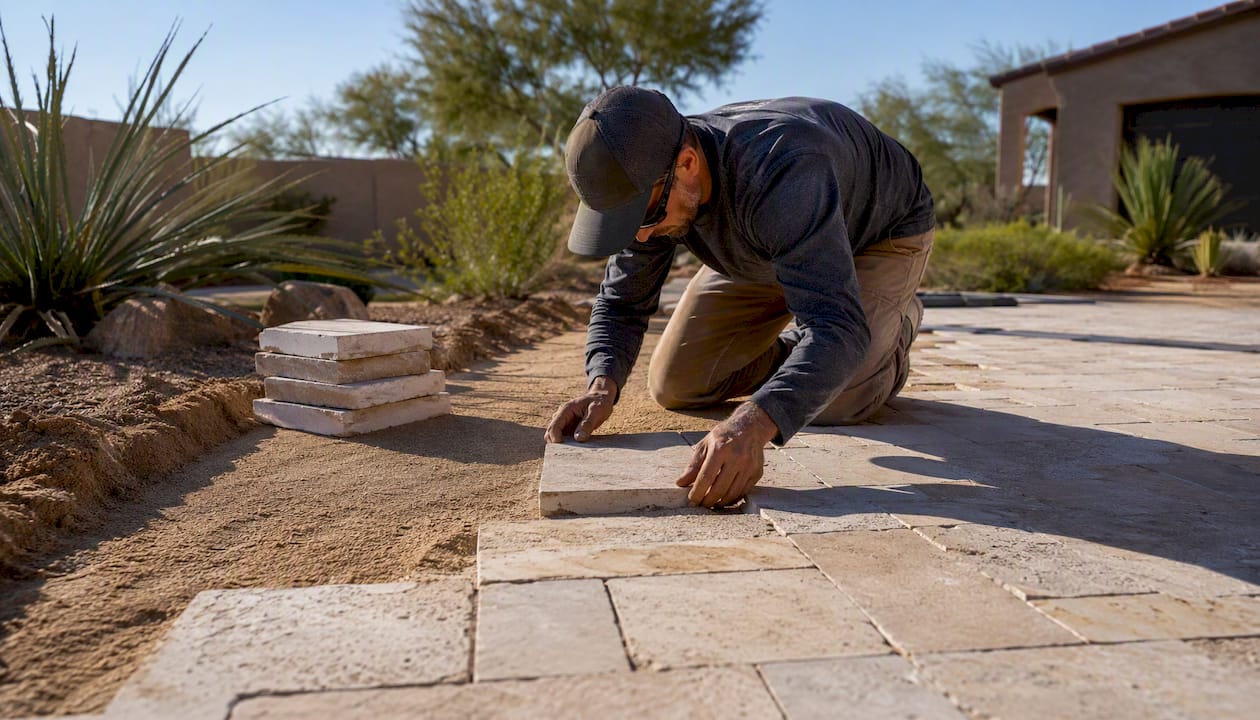
A professionally installed paver driveway typically runs $10 to $30 per square foot, landing most homeowners between $6,000 and $18,000 for a full project. Where you fall in that range comes down to three things: the paver material you pick, how much site prep your soil demands, and how far you want to push the design.
For a standard 600-square-foot driveway, here’s the quick math before you read further:
- Budget/entry-level: roughly $6,000 at $10/sq ft (standard concrete pavers, simple pattern, easy access)
- Typical/mid-range: roughly $12,000 to $15,000 at $20 to $25/sq ft (better material, moderate site prep)
- Premium: $18,000 or more at $30+/sq ft (natural stone or porcelain, complex patterns, drainage work)
Those numbers are national averages, not your quote. Keep reading for the line-item breakdown, sample math for common driveway sizes, and a contractor checklist that will make every bid you receive easier to compare.
Key Takeaways
Paver driveway cost depends primarily on material choice, site conditions, and labor, and a written line-item quote with a 10 to 15 percent contingency is the most reliable way to budget accurately.
| Point | Details |
|---|---|
| Know your per-sq-ft range | Budget $10 to $30 per square foot depending on material, with concrete pavers cheapest and natural stone most expensive. |
| Labor drives the bill | Labor commonly accounts for 30 to 50 percent of total cost, so soil, access, and pattern complexity matter as much as material price. |
| Use the estimator formula | Multiply your driveway’s square footage by your target per-sq-ft rate, then add a 10 to 15 percent contingency for site surprises. |
| Get three written bids | Compare itemized quotes covering demolition, base, materials, labor, and permits, and ask specifically about base compaction depth. |
| Work with local expertise | Jackpotlandscape has installed pavers across Tucson and Southern Arizona for over 15 years, factoring desert soil and drainage into every quote. |
Table of Contents
- How Much Does Paver Driveway Cost Vary by Material?
- What Goes Into a Paver Driveway Quote?
- What Does a Paver Driveway Cost for Common Sizes?
- What Site Factors Push the Price Higher?
- Should You DIY Your Paver Driveway or Hire a Pro?
- How Long Do Paver Driveways Last and What Do They Cost Over Time?
- How Do You Get an Accurate Paver Driveway Quote?
- Where Do These Cost Estimates Come From?
- A Local Installer’s Take on Paver Driveway Pricing
- Get a Local, Line-Item Paver Driveway Quote
- Frequently Asked Questions
- Sources
How Much Does Paver Driveway Cost Vary by Material?
Material choice is the single biggest lever on your final number. Swap concrete pavers for natural stone and you can double or triple your per-square-foot rate before a single hour of labor gets billed.
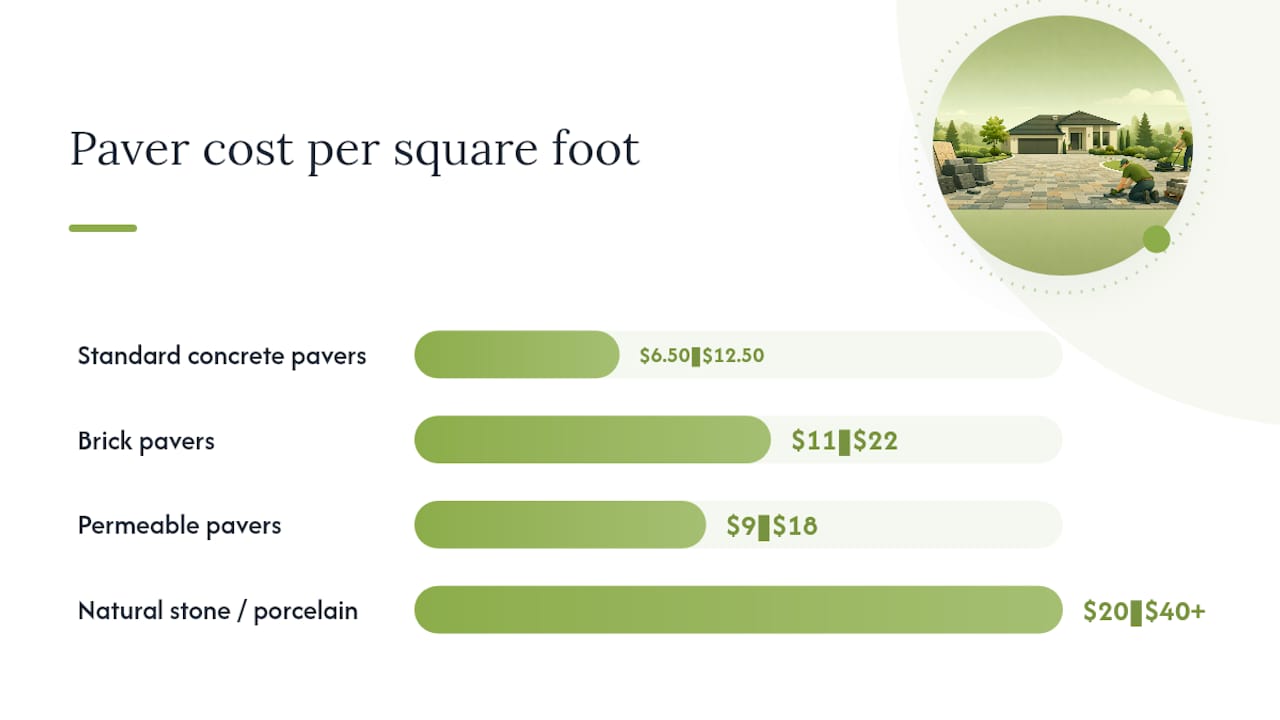
Standard concrete pavers remain the budget workhorse, and it’s not close. They run about $6.50 to $12.50 per square foot installed, come in dozens of colors and shapes molded to mimic brick or stone, and go down fast because manufacturers keep dimensions consistent. That consistency is what keeps labor costs down: less cutting, less fitting, fewer wasted units.
Brick pavers cost more, typically $11 to $22 per square foot, because clay brick is fired rather than poured and the units are smaller, meaning more pieces and more joints per square foot. They also hold color better over decades than dyed concrete, which fades.
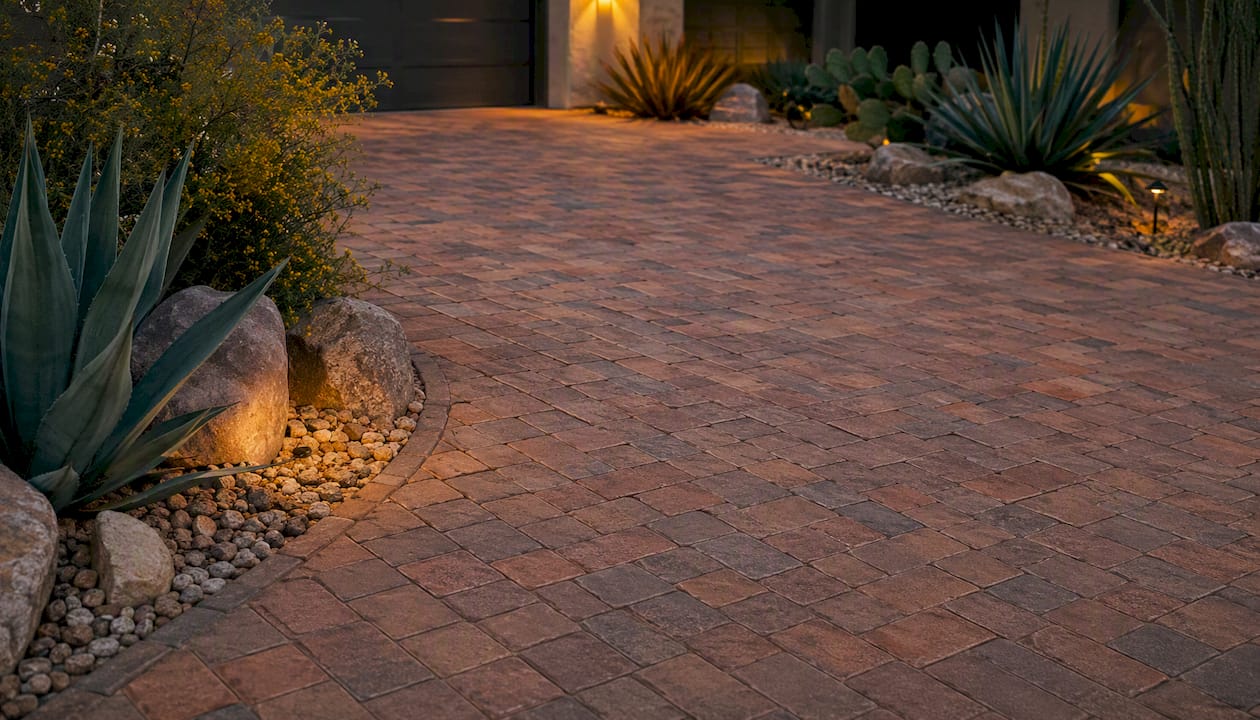
Permeable pavers sit in a similar $9 to $18 per square foot band but carry a catch: they require an engineered aggregate base with open-graded stone to let water drain through instead of pooling. That extra base work often pushes labor costs up even when the paver units themselves aren’t much pricier, and it’s one reason permeable systems frequently land in the premium tier once you total the job.
Natural stone (travertine, flagstone, granite) and porcelain pavers sit at the top of the market. Expect $20 to $40-plus per square foot once you account for material cost, the skilled labor needed to cut irregular stone to fit, and the fact that suppliers often charge a premium for driveway-rated thickness versus thinner patio-grade stone.
| Paver Type | Installed Cost per Sq Ft | Typical Price Tier |
|---|---|---|
| Standard concrete pavers | $6.50–$12.50 | Budget to mid |
| Brick pavers | $11–$22 | Mid to premium |
| Permeable pavers | $9–$18 | Mid (base work pushes cost up) |
| Natural stone / porcelain | $20–$40+ | Premium |
A few practical notes worth weighing before you fall in love with a sample at the showroom:
- Concrete pavers are the easiest to source in matching batches years later if you ever need a repair.
- Brick holds up well in freeze-thaw climates but can be more brittle under heavy vehicle loads than thick concrete units.
- Natural stone driveways need a contractor experienced in cutting stone, since a crew used to modular concrete units can waste material fast on irregular shapes.
What Goes Into a Paver Driveway Quote?
A real contractor quote isn’t one number. It’s a stack of line items, and understanding each one lets you spot where a bid is padded or where a “cheap” quote is quietly skipping something you’ll pay for later.
Here’s the typical breakdown, in the order work actually happens on site:
- Demolition and haul-away of an existing driveway, if there is one. This alone can add several hundred to a few thousand dollars depending on whether it’s asphalt, concrete, or gravel, and how far the debris has to travel to disposal.
- Excavation to the correct depth, usually 6 to 8 inches below final grade for a driveway that will carry vehicle weight.
- Compacted aggregate base, the crushed stone layer that actually bears the load. Skimping here is the number one cause of sunken, wavy pavers five years down the road.
- Bedding sand, a thin leveling layer the pavers sit directly on top of.
- Pavers themselves, cut and set to pattern.
- Edge restraints, the plastic, metal, or concrete curbing that keeps the whole field from spreading outward under traffic.
- Jointing sand or polymeric sand, swept into the gaps and, for polymeric, activated with water to lock the joints.
- Labor, which covers all of the above hands-on work.
- Permits, where your municipality requires one for driveway work.
- Cleanup and final grading of any disturbed soil or landscaping edges.
Labor is usually the biggest single expense on the invoice. Estimates commonly put labor at 30 to 50 percent of total project cost, with materials and base work splitting the rest. That’s why two quotes with identical paver brands can differ by thousands: one crew bills three days, another bills five, because of soil conditions, crew size, or how efficiently they cut around curves.
You can build a rough budget yourself with a simple formula:
Estimated cost = (driveway area in sq ft × per-sq-ft rate) + contingency + permit/hauling allowance
So a 500-square-foot driveway at $18/sq ft comes to $9,000 before extras. Add a contingency (more on that below) and any demolition allowance, and you’re within shouting distance of what a written quote will show.
Pro Tip: Add a 10 to 15 percent contingency to any driveway estimate before you commit to a budget, as contractors routinely find soft spots, old debris, or drainage issues once excavation starts. That buffer is what keeps a surprise from turning into a stalled project or an argument over a change order.
What Does a Paver Driveway Cost for Common Sizes?
Per-square-foot numbers are useful, but most homeowners think in terms of “what will my driveway cost.” Here’s how the math plays out across the sizes people actually search for, using $10, $20, and $30 per square foot as low, typical, and premium anchors.
The 480-square-foot line matters most, since it represents the standard two-car driveway most quotes get built around, and it lines up closely with published national ranges of roughly $4,800 to $14,400 installed.
To apply this to your own driveway, measure length times width in feet to get your square footage, then multiply by whichever per-square-foot rate matches the material tier you’re considering from the table above. A 30-foot by 18-foot driveway is 540 square feet. At a typical $20/sq ft rate, that’s $10,800 before contingency or site-specific extras.
- Round up your measurement slightly. Driveways rarely come out to clean rectangles, and contractors bill for actual pavers cut, not your theoretical footprint.
- If your driveway curves or wraps around a garage angle, expect the pattern-complexity factors in the next section to push you toward the higher end of your material’s range.
What Site Factors Push the Price Higher?
Two driveways of identical size and material can come in thousands apart because of what’s under and around them. These are the factors that move a quote the most, and knowing which ones are negotiable helps you decide where to spend and where to hold firm.
- Soil type and compaction: Clay soil holds water and shifts seasonally, often requiring deeper excavation and extra base material to prevent heaving; sandy, well-draining soil is cheaper to prep.
- Slope and grading: A driveway on a grade needs retaining or regrading work, and steep slopes can require engineered drainage solutions that add real cost.
- Drainage: Standing water problems, gutters that dump onto the driveway, or a low point that collects runoff often mean French drains or channel drains, typically priced per linear foot.
- Access and haul distance: A driveway a truck can back straight up to costs less to build than one requiring wheelbarrow runs from the street, since every extra minute of material transport is billed as labor.
- Pattern complexity: Herringbone and basket-weave patterns take noticeably longer to cut and fit than a simple running bond, and that extra labor time shows up directly in your quote.
- Borders and inlays: A contrasting soldier-course border or a custom inlay is a common upsell, and this kind of decorative add-on can run anywhere from $1,000 to $12,000-plus depending on scope.
- Retaining walls: If your driveway needs a wall to hold back a slope, that’s essentially a second project priced separately, often by linear foot of wall.
- Heating systems: Embedded snow-melt systems are a premium, cold-climate add-on that meaningfully raises both material and installation cost.
Soil, slope, and drainage are not really negotiable. They’re physical realities a contractor has to design around, and cutting corners there is exactly how driveways fail early. Pattern and borders, on the other hand, are pure preference. If your budget is tight, a straightforward running-bond pattern in a single paver color will always cost less than a herringbone field with a soldier-course border, and it will hold up just as well structurally.
Should You DIY Your Paver Driveway or Hire a Pro?
For a driveway, hire a professional. The math and the risk both point the same direction, and this is the one category where DIY savings rarely survive contact with reality.
Here’s the honest comparison:
- DIY pros: No labor markup, control over timeline, satisfaction of doing it yourself.
- DIY cons: Plate compactor and other equipment rental, physically demanding excavation work, no warranty if the base fails, steep learning curve on getting grade and drainage right the first time.
- Hiring a pro, pros: Warranty on workmanship, experienced base compaction (the single biggest factor in long-term performance), faster completion, insurance coverage if something goes wrong.
- Hiring a pro, cons: Labor cost, which as noted runs 30 to 50 percent of the total project.
Run the numbers on a typical 480-square-foot driveway. DIY materials alone (pavers, base rock, sand, edge restraints) might run $3,000 to $5,000, plus a few hundred dollars in compactor and tool rental for a weekend. That looks like real savings against a $9,600 professional quote at the typical $20/sq ft rate. But a driveway carries vehicle weight every single day, and a base that isn’t compacted to spec will show sunken pavers and shifting joints within a year or two, not a decade. Fixing that means tearing out and redoing the work you already paid for once.
DIY makes sense for small, low-traffic projects: a single walkway, a garden path, a small patio extension where a mistake means an inconvenience rather than a structural failure. For a driveway that has to carry your car, your neighbor’s car, and probably a delivery truck at some point, professional installation with proper compaction equipment is worth the labor line item.
How Long Do Paver Driveways Last and What Do They Cost Over Time?
Pavers cost more upfront than poured concrete but usually win on lifetime value, because you repair a section instead of replacing a slab.
Expect this maintenance rhythm over the life of the driveway:
- Joint sand refill as needed, typically every year or two depending on traffic and weather.
- Resealing every 3 to 5 years, which protects color, locks polymeric jointing sand in place, and makes future cleaning easier.
- Occasional power washing to clear grime, oil spots, or efflorescence, usually once or twice a year.
- Spot repairs as needed. If a section settles or cracks, a contractor lifts those specific pavers, fixes the base issue underneath, and resets them, matching color from the same batch if you kept extras.
That last point is where pavers separate from concrete. A concrete driveway that cracks generally needs the whole slab, or at minimum a full section, replaced and re-poured, since concrete is one continuous pour. A paver driveway with the same underlying problem gets fixed piece by piece.
Run a rough amortized comparison: a $12,000 paver driveway maintained with resealing every 4 years and occasional spot repairs, spread over a 25-plus year service life, works out to roughly $480 a year before repairs. A concrete driveway costs less upfront, often $4,000 to $8,000 for a similar size, but tends to need full replacement sooner and offers no partial-repair option, which is where amortized cost-per-year comparisons increasingly favor pavers despite the higher sticker price.
- Concrete: lower upfront cost, cracks are visible and hard to hide, full-slab replacement when it fails.
- Asphalt: cheapest upfront, needs resealing every 2 to 3 years, softens in extreme heat.
- Pavers: highest upfront cost, spot-repairable, holds resale appeal in most markets.
How Do You Get an Accurate Paver Driveway Quote?
Getting three written, line-item quotes is the single best thing you can do to protect your budget. A verbal ballpark number is not a quote, and any contractor unwilling to itemize costs on paper is a warning sign worth taking seriously.
Follow this sequence before you sign anything:
- Measure your driveway area yourself so you can sanity-check every bid against the same square footage.
- Request an itemized quote broken out by demolition, base, materials, labor, and extras, not a single lump sum.
- Ask for base compaction specs in writing: depth of aggregate base, type of compactor used, and how many passes.
- Check licensing and insurance, and ask for at least two local references you can actually call.
- Confirm the timeline, including how weather delays are handled and what happens if excavation reveals unexpected soil issues.
Questions worth asking every contractor before you compare prices:
- What warranty do you offer on workmanship, and for how long?
- What’s your standard base depth for a driveway, and does it change for clay or sandy soil?
- What edge restraint system do you use, and is it included in the quoted price?
- Do you have a drainage plan for this specific site, and is it in the quote?
- Who pulls the permit, and is that fee included or billed separately?
Red flags to watch for: a quote significantly below the others with no explanation, no mention of base depth or compaction method, a request for full payment upfront, or reluctance to put anything in writing. Negotiate fixed pricing on the core install (base, pavers, labor) and treat decorative extras like borders or lighting as optional line items you can add or cut without renegotiating the whole contract.
Pro Tip: Schedule your quotes during the same two-week window. Material and labor pricing shifts seasonally, and comparing a quote from March against one from August can make identical work look wildly different in price when it’s really just timing and seasonal demand at play.
Budgeting tip: build your contingency into the number you compare quotes against, not just the final signed contract. If your working budget is $12,000, treat $10,000 to $10,500 as your target bid range so the 10 to 15 percent contingency has room to breathe.
Where Do These Cost Estimates Come From?
These ranges are built from a combination of national cost-guide data, contractor-facing estimator tools, and retail material pricing, cross-checked against each other for consistency rather than pulled from a single source.
- Industry cost guides from Angi and HomeAdvisor provide the backbone per-square-foot and total-project ranges.
- Estimator and calculator tools like RemodelCalculators and Current Cost supply material-specific benchmarks and amortized lifetime-cost comparisons.
- Marketplace quote data from platforms like Thumbtack shows how real-world bids break demolition and site prep out as separate line items.
- Retail material pricing from suppliers such as Home Depot helps triangulate raw material costs, though those prices don’t include base work or labor.
The core assumptions behind these numbers: a compacted aggregate base of 6 to 8 inches for driveway-rated pavers, standard compaction protocol, average regional labor rates without major drainage remediation unless specifically noted, and no unusual access restrictions. Your actual quote will vary based on where you live, your soil, and your local labor market, which is exactly why a site visit and a written local bid always beats a national average.
A Local Installer’s Take on Paver Driveway Pricing
After more than 15 years installing pavers, travertine, and turf across Tucson and Southern Arizona, the biggest gap I see isn’t between “cheap” and “expensive” contractors. It’s between quotes that account for our soil and climate and quotes that were built off a generic national template.
Southern Arizona’s caliche soil and monsoon drainage patterns change the base-prep math in ways a cost guide written for the whole country simply can’t capture. A driveway quote that looks identical to one from a wetter, softer-soil region can hide a base that’s inadequate for our summer heat cycles and sudden downpours. That’s not a scare tactic, it’s just physics: compacted base depth and drainage planning matter more here than in most markets, and skipping that step is the single fastest way to end up with a driveway that sinks or shifts within a few years.
Jackpotlandscape has installed interlocking pavers, travertine, and hardscape features across Tucson and Southern Arizona for over 15 years, with completed driveway, patio, and pool deck projects homeowners can view directly. National per-square-foot ranges are a useful starting point, but a real number for your property comes from a site visit, not a spreadsheet.
Get a Local, Line-Item Paver Driveway Quote
National cost ranges get you in the ballpark, but the only number that matters is the one built around your soil, your access, and your design. Jackpotlandscape has spent over 15 years installing paver driveways, patios, and pool decks across Tucson and Southern Arizona, which means every quote factors in caliche soil, monsoon drainage, and desert heat cycles from day one instead of treating your property like a generic template.
Homeowners choose Jackpotlandscape for straightforward, itemized pricing on paver installation, covering base prep, grading, drainage, and the paver work itself, so there are no surprise add-ons once excavation starts. You can browse finished examples, including a Tucson paver patio project, to see how base and pattern choices hold up in real desert conditions years after installation.
If you’re ready to turn a national estimate into a real number, request a written, line-item quote and an on-site visit through Jackpotlandscape’s paver installation page. Bring your measurements, and you’ll walk away with a bid that reflects your actual property, not a national average.
Frequently Asked Questions
How much does a paver driveway cost on average? Most professionally installed paver driveways cost $6,000 to $18,000 total, or about $10 to $30 per square foot depending on material and site conditions.
Is pavers vs concrete driveway cost really that different? Yes. A concrete driveway usually costs less upfront, but pavers tend to win on amortized cost per year because spot repairs replace individual units instead of an entire slab.
What’s the cheapest paver option for a driveway? Standard concrete pavers, running roughly $6.50 to $12.50 per square foot installed, are typically the most budget-friendly choice that still holds up under vehicle traffic.
How much does labor cost for a paver driveway? Labor commonly makes up 30 to 50 percent of the total project cost, driven mainly by base excavation, compaction, and how complex your chosen pattern is to cut and fit.
Should I get multiple quotes for a paver driveway? Always get at least three written, itemized quotes. Comparing base compaction specs, warranty terms, and line-item pricing side by side is the best way to spot an underpriced bid that’s cutting corners.
Does removing an old driveway add to the cost? Yes. Demolition and haul-away of an existing driveway can add several hundred to a few thousand dollars, depending on the material and disposal distance.
Sources
- How Much Does a Paver Driveway Cost? 2026 Data | Angi
- How Much Does It Cost to Install a Paver Driveway? 2025 Data | HomeAdvisor
- Driveway Cost (2026) — Gravel, Asphalt, Concrete, Pavers | RemodelCalculators
- Low Cost Driveway Pavers Price Guide for U.S. Buyers 2026 – Current Cost
- Cost to Pave Driveway | Thumbtack