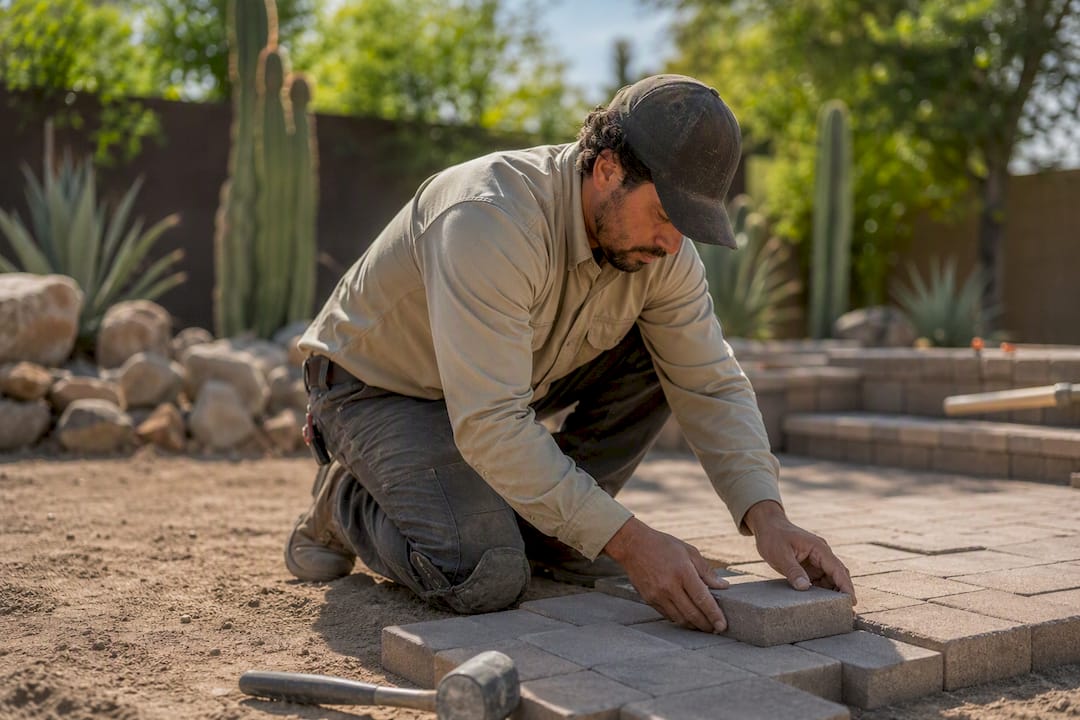
Expect to pay about $12 to $30 per square foot installed for a typical paver patio, with most homeowners landing somewhere in the middle depending on material and site conditions. A 300 square foot patio, roughly the size of a two-car garage, usually runs $3,600 to $9,000 installed, and national data from Thumbtack puts many completed projects between $1,425 and $6,387 depending on scope.
Three things move that number more than anything else: the material tier you pick, how much excavation and base work the site needs, and the pattern complexity you ask the crew to cut. Concrete pavers sit at the affordable end. Natural stone and travertine push toward the top. Labor and base preparation, not the pavers themselves, usually eat the largest share of your budget.
- Budget material (concrete pavers): roughly $12–$20 per sq ft installed
- Mid-tier (brick or porcelain): roughly $14–$30 per sq ft installed
- Premium (natural stone, travertine): roughly $20–$50 per sq ft installed
Key Takeaways
Paver patio cost depends far more on base preparation and labor than on the pavers themselves, since material typically makes up only about 20% of the total installed price.
| Point | Details |
|---|---|
| Topline cost range | Expect $12 to $30 per square foot installed, or $3,600 to $9,000 for a typical 300 sq ft patio. |
| Base and labor dominate | Excavation, gravel base, and labor account for most of the total cost, not the pavers. |
| Material sets the ceiling | Concrete runs $12 to $20 per sq ft; natural stone and travertine can reach $50 per sq ft. |
| Patterns add labor cost | Herringbone adds roughly 10 to 15% to labor, curved layouts can add 15 to 25%. |
| Get matching bids | Request excavation depth, base spec, and edge restraint type in writing from every contractor before comparing quotes. |
| Local example matters | Jackpot Landscaping’s Tucson travertine job spent more on base work alone than on the material itself. |
Table of Contents
- Paver Patio Cost by Size: What Common Projects Actually Run
- How Material Choice Changes Your Paver Patio Cost
- What Actually Drives Paver Patio Installation Prices
- DIY vs. Hiring a Pro for Your Paver Patio
- How to Get Comparable Paver Patio Quotes
- What a Real Tucson Paver Job Actually Cost
- Why Local Climate Should Shape Your Material Choice
- Sources
Paver Patio Cost by Size: What Common Projects Actually Run
Per square foot pricing drops slightly as your patio grows, because mobilization, equipment delivery, and site setup are fixed costs the contractor spreads across more square footage. A tiny 8x8 patio pays a premium for the same truck roll and crew setup as a 400 square foot job, so small patios often carry a higher effective rate per foot.
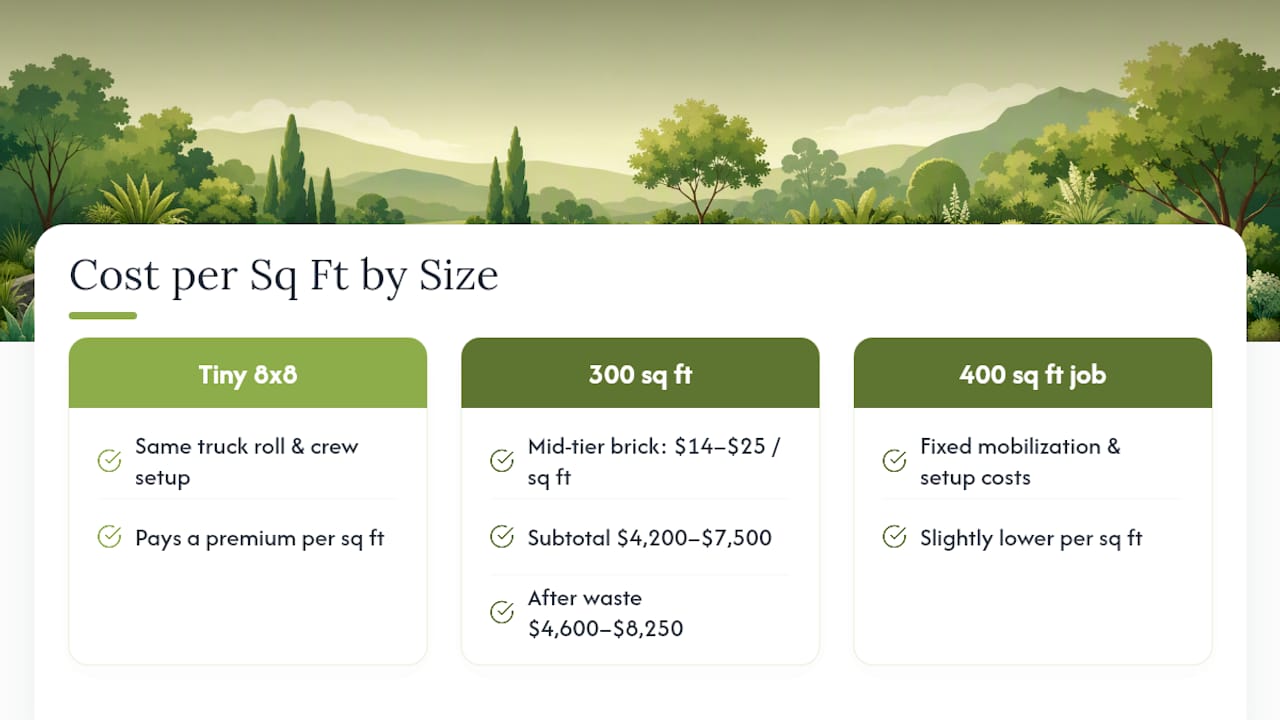
Here’s how that plays out across the sizes homeowners ask about most, with estimates varying by project specifics and location.
To scale your own dimensions, multiply length by width for square footage, then multiply by your chosen per-foot rate. Add 5 to 10% on top for waste, cuts, and breakage. A 300 square foot layout using mid-tier brick at $14–$25 per sq ft, for example, lands around $4,200–$7,500 before that waste buffer, and closer to $4,600–$8,250 after it. ProjectCostPro’s calculator is a solid way to sanity-check your own dimensions against current size-based averages.
How Material Choice Changes Your Paver Patio Cost
Concrete pavers remain the budget workhorse and are usually among the more affordable materials, offering many style options and decent durability.
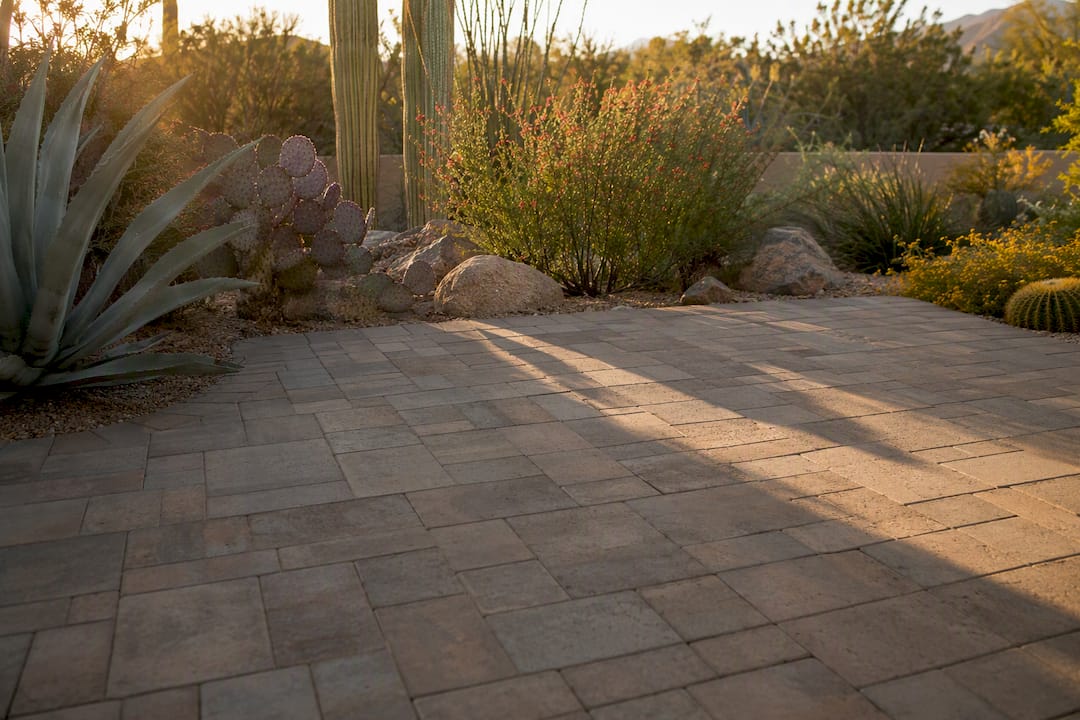
Brick sits a notch higher, around $14–$25 per square foot, according to UseCalcPro’s 2026 breakdown. It has a classic look that ages well but can be more brittle in freeze-thaw climates.
Porcelain pavers generally have higher upfront cost but offer advantages in stain and fade resistance and require less maintenance.
Natural stone and travertine tend to be in the premium cost tier and provide benefits such as cooler surfaces in hot climates.
Pattern complexity adds its own line item regardless of material:
- Running bond or basic grid patterns: no meaningful labor premium
- Herringbone: commonly adds 10–15% to labor for the extra cutting and layout time
- Circular pavers or curved borders: often adds 15–25%, since nearly every paver needs a custom cut
What Actually Drives Paver Patio Installation Prices
Here’s the part most homeowners underestimate: the pavers themselves are usually a minor line item. According to Unilock, paver material typically accounts for only about 20% of the total installed project cost.
That invisible work includes excavating 6 to 9 inches of soil (deeper in clay or freeze-prone regions), laying and compacting a crushed stone base, adding a leveling layer of bedding sand, and compacting the whole system in stages so it doesn’t shift or sink later. UseCalcPro’s analysis puts labor and base work often constitute a majority of the total installed cost on many jobs.
A few other cost drivers stack on top of base prep:
- Drainage grading or a French drain if your yard already holds water
- Edge restraints (plastic, aluminum, or concrete) to keep pavers from spreading over time
- Removal and disposal of old concrete, grass, or gravel
- Permits, which some municipalities require for patios attached to the house or near property lines
- Difficult site access, which adds labor hours for hand-carrying material
Statistic Callout: On a typical job, pavers may represent around one-fifth of the budget, while excavation, base, and labor make up most of the rest.
Pro Tip: Before you sign anything, ask the contractor to write the base depth and compaction method into the scope of work. A crew cutting corners on base prep is the single most common reason patios crack or sink within two or three years.
DIY vs. Hiring a Pro for Your Paver Patio
DIY materials and tool rental for a small patio typically run $8–$15 per square foot, since you’re skipping labor but still paying for pavers, base gravel, sand, edge restraints, and a plate compactor rental. Professional installation runs the full $12–$30 per square foot range because it includes skilled labor, equipment, and a warranty on the work.
The risk with DIY, or with a low-bid contractor cutting the same corners, is what happens underground. An improperly compacted base or missing drainage plan doesn’t show up on day one. It shows up 18 months later as sinking pavers, pooling water, or shifted edges, and fixing it after the fact often costs more than doing the base right the first time.
DIY makes sense for small, flat, easily accessible areas, roughly under 120 square feet, with good existing drainage. Hire a pro when you’re dealing with sloped or clay-heavy soil, poor drainage, or a patio that connects to a fire pit, retaining wall, or outdoor kitchen. Complex features raise the cost of a mistake fast.
How to Get Comparable Paver Patio Quotes
Getting three bids that quote the exact same scope is the only way to compare numbers honestly, since one contractor’s “$12 per foot” and another’s can mean two very different jobs underneath.
- Confirm excavation depth in inches, and ask whether it changes based on soil type.
- Get the base spec in writing, including gravel type and compaction passes.
- Ask about edge restraint material (plastic, aluminum, or concrete) and installation method.
- Clarify drainage plans, especially if your yard has ever pooled water.
- Ask what the warranty covers and for how long, both on labor and material.
- Get disposal fees itemized separately if old concrete or sod needs removal.
A simple scope-of-work paragraph you can share with contractors: “Install a [size] square foot paver patio using [material], with a [depth]-inch excavated and compacted gravel base, sand setting bed, [edge restraint type], and drainage graded away from the foundation. Include disposal of removed material and a written warranty on workmanship.”
Lead times vary by season, and Thumbtack’s data notes that scheduling outside peak spring and summer months can improve both availability and pricing. Check with your municipality on permit requirements before locking in a start date.
What a Real Tucson Paver Job Actually Cost
That split tracks closely with the national pattern where base and labor dominate the invoice. If you want to verify a contractor is doing the work they’re billing for, ask them to show cubic yards of gravel delivered and linear feet of edge restraint installed. Both numbers should match the square footage of your patio. You can see similar completed work on Jackpot Landscaping’s paver patio projects page.
Why Local Climate Should Shape Your Material Choice
Climate changes which material makes financial sense over the life of your patio, not just which one looks best on day one. In freeze-thaw regions, water trapped under pavers expands when it freezes, and repeated cycles can heave joints or crack poorly-set units. Concrete and brick pavers with tight joint sand and solid edge restraints hold up better there than loosely fitted natural stone.
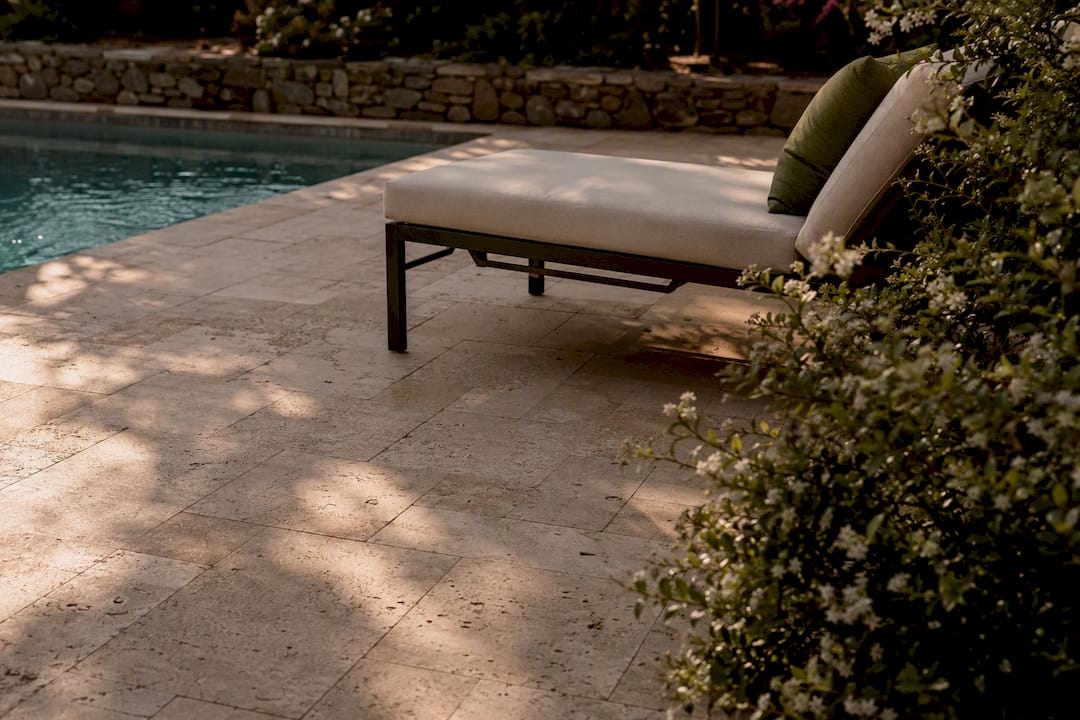
In hot, dry climates like the desert Southwest, heat is the bigger enemy. Dark concrete pavers absorb and radiate heat, making a patio uncomfortable to walk on barefoot by midafternoon. Travertine stays noticeably cooler because of its natural porosity and lighter tones, which is why it’s a popular upgrade for pool decks and shaded seating areas despite the higher upfront cost.
UV exposure also matters. Cheaper concrete pavers can fade over years of intense sun, while porcelain and natural stone hold their color far longer. If you’re budgeting for the long haul rather than just the install day, factor in how many years you expect before resealing, replacing faded units, or repairing frost damage. A slightly pricier material that avoids those repeat costs often wins on total cost of ownership, even if it loses on the initial invoice.
A Contractor’s Take on Where Homeowners Under-Budget
Most homeowners who call us after a patio problem skimped on the same two things: base depth and drainage. They saved a few hundred dollars upfront and paid for it in repairs within a few years. My advice is simple: spend on the base first, then adjust the material tier to fit what’s left in your budget.
Get a Real Quote for Your Tucson Paver Patio
National ranges are a useful starting point, but soil conditions, monsoon drainage needs, and material availability in Southern Arizona all shift the number in ways a generic calculator can’t capture. Jackpot Landscaping installs travertine and interlocking paver patios throughout Tucson and Southern Arizona, and every estimate is built around your actual yard, not a national average.
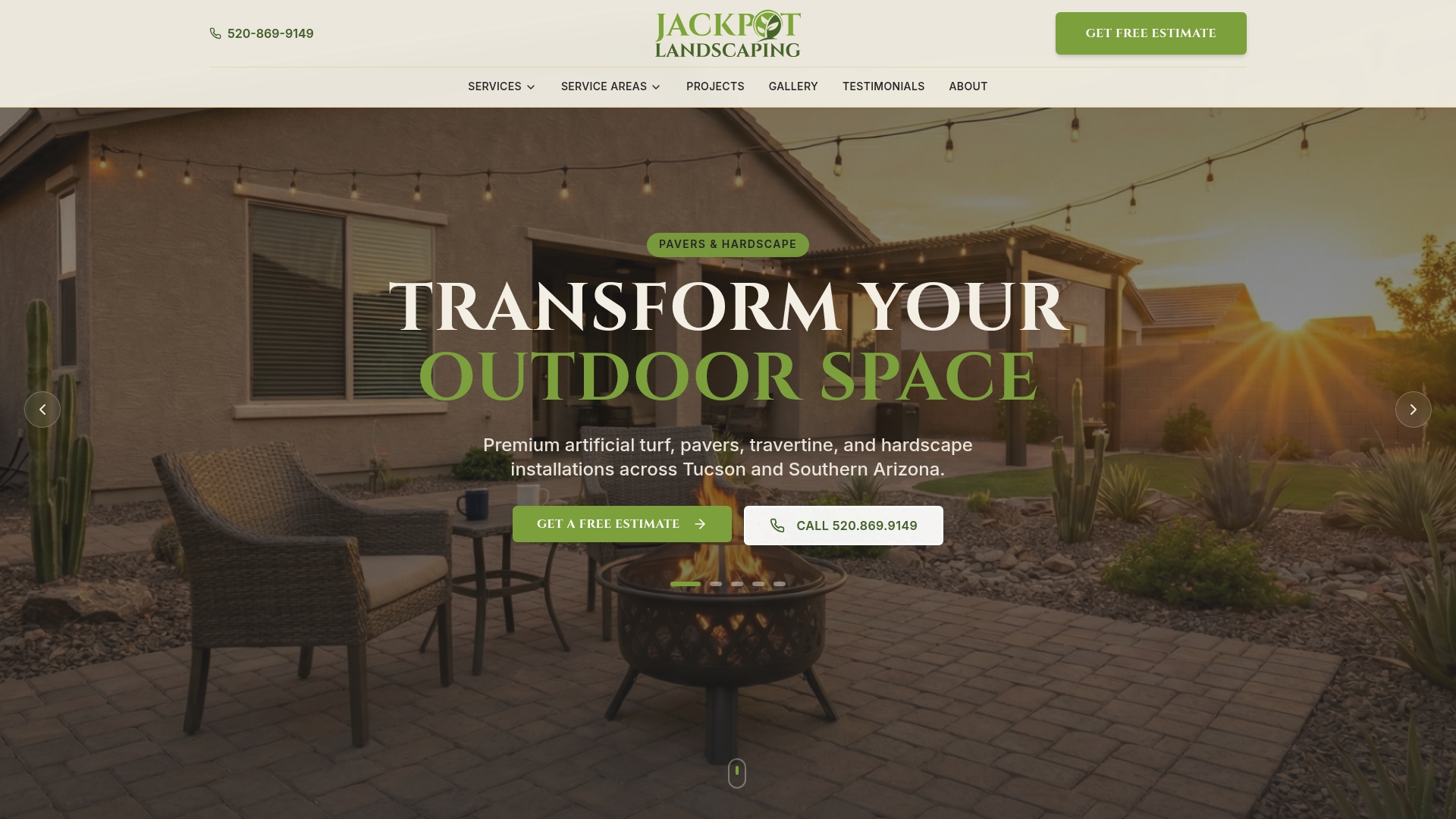
Our crews handle the excavation, compacted base, drainage grading, and finishing work in-house, so the invoice you get matches the scope you actually need, not a stripped-down bid that gets padded with change orders later. If you want to see completed work before reaching out, browse Jackpot Landscaping’s project gallery for examples across different sizes and materials. When you’re ready to put real numbers against your own yard, request a free estimate through Jackpot Landscaping’s paver installation page and get a scope built around your soil, your drainage, and your budget.
Sources
- How Much Does a Paver Patio Cost? | Unilock
- 2026 Paver Patio Cost Installed: Get Price Quotes | Thumbtack
- How Much Does a Paver Patio Cost in 2026? (Materials, Labor & Size) | UseCalcPro
- Paver Patio Cost Calculator (2026) | Brick & Flagstone