Stop Dog Urine Odor on Turf With Contractor Grade DIY and Pro Fixes
Stop Dog Urine Odor on Turf With Contractor Grade DIY and Pro Fixes
Rinse fresh urine spots right away and follow with a turf-safe enzymatic cleaner; that stops staining before it starts. If the smell is already baked in, hosing it down won’t help and can even make the ammonia worse. That requires a microbe-based deep clean that reaches the infill, plus solid drainage and a pet potty routine to keep it from coming back. When the odor survives proper treatment or the base looks damaged, it’s time to call a turf pro.
TL;DR:
- Immediate rinsing and turf-safe enzymatic cleaning effectively prevent fresh urine stains and odors if done within a few hours.
- Deep cleaning with microbe-based products is necessary for baked-in odor, especially when crystals have formed in the infill and backing.
- Proper turf installation with correct slope, drainage, and infill choices significantly reduces recurring odor issues over time.
- Regular maintenance, including weekly rinses and microbial treatments every two to four weeks, is essential for ongoing odor control.
- When odor problems persist despite proper cleaning and maintenance, calling a turf professional to assess drainage and base stability is the best course of action.
Table of Contents
- How Do You Handle Fresh Dog Urine on Turf?
- How Do You Deep Clean Baked-In Urine Odor From Turf?
- Why Does Artificial Turf Trap Dog Urine Smell in the First Place?
- What’s a Realistic Maintenance Schedule for Pet Turf?
- When Should You Call a Turf Pro Instead of Cleaning It Yourself?
- What Do 15 Years of Turf Installs Teach You About Dog Owners’ Mistakes?
- Get a Turf System Built to Handle Dogs, Not Just Survive Them
- Sources
How Do You Handle Fresh Dog Urine on Turf?
Fresh urine is the easy case, but only if you act within a few hours. Wait a day or two and uric acid starts crystallizing into the base, which is a much tougher problem.
- Pick up solids first, then blot the wet spot with a towel instead of rubbing it. Rubbing pushes urine deeper into the fibers and backing.
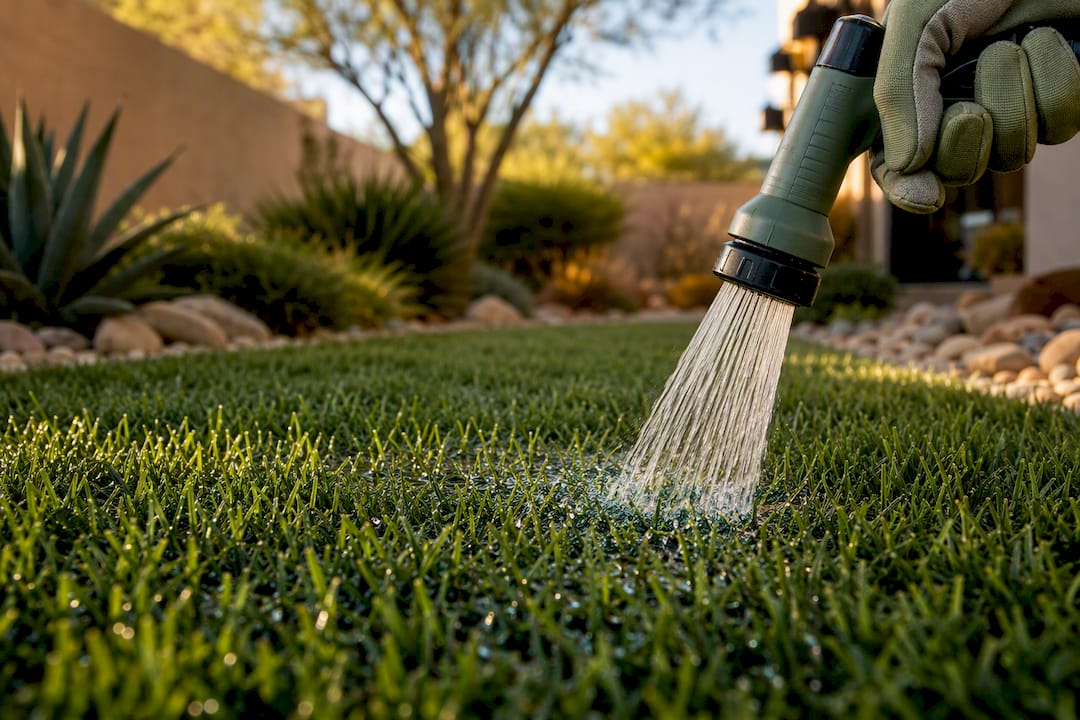
- Rinse with a gentle hose stream, not a pressure nozzle. Slow water dilutes the urine and carries it through the backing rather than spreading it sideways.
- Spot-treat with a turf-safe enzymatic cleaner. These products break down odor-causing compounds when given proper dwell time, according to Simple Green’s cleaning guidance. Follow the label. More product doesn’t mean faster results.
- Keep dogs off the spot until it’s dry. Wet turf that gets walked on again just spreads the residue back around.
If the smell returns a day later, that’s usually a sign the urine had already started drying before you got to it, and you’ll need the deeper protocol below.
Pro Tip: Treat the same three or four spots your dog favors as a standing “hot zone,” not a one-off mess. Dogs are creatures of habit, and hitting those exact spots weekly beats reacting after the fact.
How Do You Deep Clean Baked-In Urine Odor From Turf?
Dried urine leaves behind uric acid crystals that don’t dissolve in water. They sit in the infill and backing and off-gas ammonia every time heat or humidity hits them, which is exactly why a quick rinse often makes the smell sharper instead of better, per INSTALL-IT-DIRECT’s turf guide. Water moves the crystals around; it doesn’t break them down. Vinegar has the same problem: it can mask the smell for an hour, but it does nothing to the crystals themselves, and repeated use can leave residue that attracts dirt, according to the same source.
The actual fix is biological, not chemical. Live bacteria in microbe-based cleaners consume uric acid the way enzymes are supposed to but often can’t manage outdoors, per INSTALL-IT-DIRECT.
- Pre-rinse the area lightly to dampen the surface, not saturate it.
- Apply a heavy, even layer of microbial cleaner over the affected zone.
- Work it into the fibers with a stiff brush, rake, or power broom so it reaches the infill, not just the tips of the blades.
- Let it sit overnight. Microbes need hours, not minutes, to digest crystals sitting deep in a compacted base.
- For a long-baked-in spot, cover it with a tarp to trap moisture. That keeps the bacteria alive and active long enough to reach crystals buried in the base material.
- Rinse thoroughly the next day and let the area air out.
A few things matter here beyond the steps:
- Skip bleach and harsh household cleaners. They can damage turf backing and won’t touch the uric acid anyway.
- Apply at dusk or during cooler hours. UV and heat kill the bacteria before they finish the job.
- Keep pets off the tarped or wet area until it’s fully rinsed and dry.
Pro Tip: If one spot keeps coming back smelly after a proper microbial treatment, that’s a base problem, not a cleaning problem. No amount of extra product fixes a drainage issue underneath.
Why Does Artificial Turf Trap Dog Urine Smell in the First Place?
Real grass and soil let urine filter through and break down naturally. Turf doesn’t work that way, and understanding the mechanics saves a lot of wasted effort on the wrong fix.
Urine contains urea, which converts into uric acid. That acid forms crystals that don’t dissolve in water and settle into the base material under the turf, where they release ammonia gas when warmed, according to INSTALL-IT-DIRECT. That’s why a yard can smell fine in the morning and reek by mid-afternoon.
- Enzymatic cleaners break molecules apart on contact, which works well for a fresh spill but has limits outdoors where reapplication is constant.
- Microbe-based cleaners contain live bacteria that actually digest uric acid crystals, addressing the source rather than the surface, per INSTALL-IT-DIRECT.
- Infill matters more than most owners realize. Zeolite and antimicrobial-coated infills can trap or neutralize ammonia before it escapes, while standard silica sand or crumb rubber offers little odor resistance on its own.
- Drainage and backing decide the ceiling on all of this. A permeable backing over a well-sloped base lets urine pass through instead of pooling. A compacted or poorly graded base holds moisture and odor no matter how good your cleaner is.
One consistent theme across turf care guidance: university extension research warns against home remedies like baking soda or dish soap, since dilution and proper drainage do far more than any pantry-shelf fix.
What’s a Realistic Maintenance Schedule for Pet Turf?
Odor control isn’t a one-time job. It’s a rhythm, and the right cadence depends on how many dogs you have and how hot your summers run.
- Weekly: pick up solid waste daily if possible, and give bathroom zones a light rinse.
- Every two to four weeks: spot-treat high-use areas with an enzyme or light microbial spray, especially through warmer months. Power-brush matted spots to keep fibers upright and airflow moving.
- Once a year, or when odor lingers: run a full microbial saturation treatment, break up any compacted base material, and consider refreshing or upgrading infill to a zeolite or antimicrobial blend.
- Adjust for climate and dog count. Hot, humid stretches accelerate off-gassing, so shorten the interval between treatments. A household with two or three large dogs needs roughly double the attention of a single small dog.
This routine tracks with the frequency most pet turf specialists recommend: daily waste pickup, weekly rinsing, and monthly enzyme treatment as a baseline, scaled up for heavier use.
When Should You Call a Turf Pro Instead of Cleaning It Yourself?
Some odor problems aren’t cleaning problems at all. They’re installation problems wearing a smell as a symptom.
- Ammonia smell persists even after a full microbial deep clean with proper dwell time.
- Water pools on the surface or drains slowly after rain or rinsing.
- Fibers stay matted and flat in the same spots no matter how much you brush them.
- You can see cracks, gaps, or lifting at the turf backing or seams.
A contractor checks base compaction, drainage slope, and whether the infill has saturated past the point of doing its job. Sometimes the fix is power-brooming and adding fresh infill. Other times the backing has broken down enough that patching won’t hold, and a full section replacement costs less over three years than repeated service calls on a turf that was never draining correctly to begin with.
What Do 15 Years of Turf Installs Teach You About Dog Owners’ Mistakes?
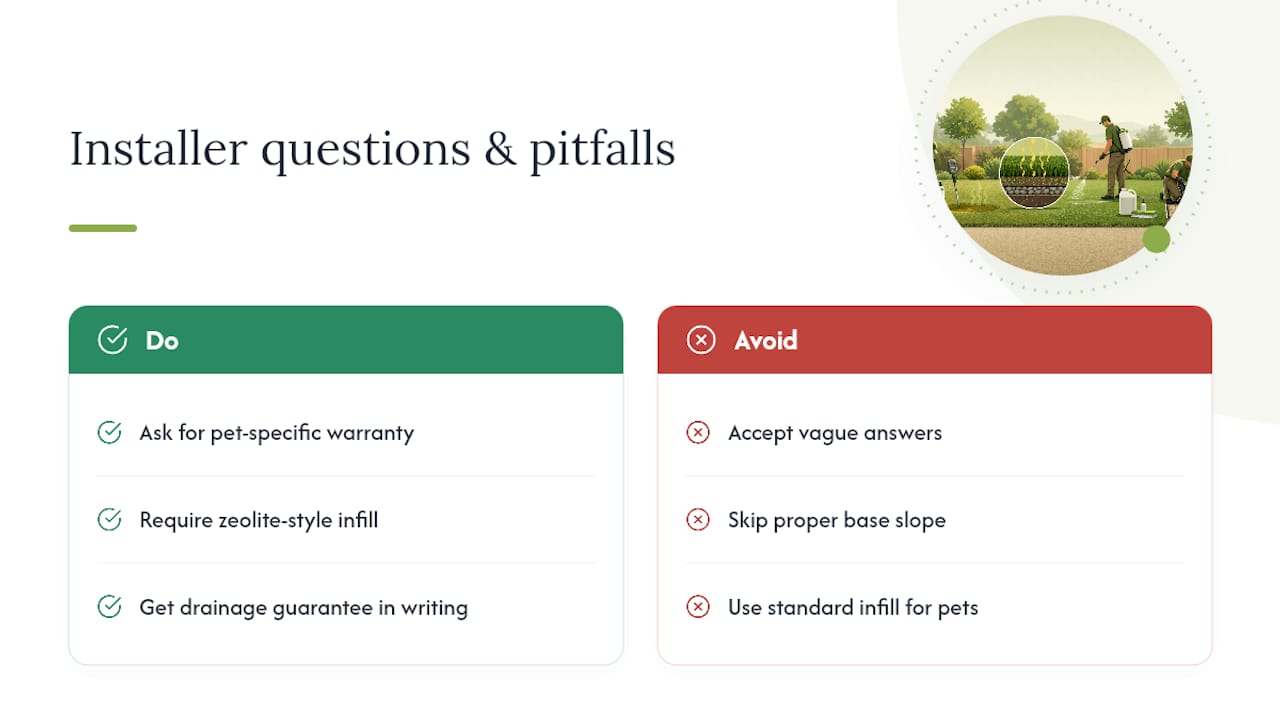
Most odor complaints Jackpotlandscape sees trace back to installation shortcuts, not owner neglect. A base that wasn’t sloped correctly, backing that doesn’t drain fast enough, or standard infill where a pet-optimized blend belonged. Projects in Oro Valley and Sahuarita reinforced the same lesson twice: proper base prep and a zeolite-style infill up front save owners years of chasing smells with sprays.
If you’re hiring anyone for a pet-friendly turf job, ask three things: what warranty covers pet use specifically, what infill they’re specifying, and whether they’ll guarantee drainage performance in writing. A vague answer to any of those is worth walking away from.
— Noah
Get a Turf System Built to Handle Dogs, Not Just Survive Them
If you’ve already tried the rinse-and-spray routine and the smell keeps winning, the fastest lasting fix is upgrading what’s underneath the grass, not buying another bottle of cleaner. Jackpotlandscape has spent over 15 years installing and repairing turf systems across Tucson and Southern Arizona, and pet odor issues almost always trace back to base prep, drainage, or infill choice rather than cleaning habits.

Our crews handle full microbial deep cleans for turf that’s already down, swap standard infill for zeolite or antimicrobial blends designed for heavy dog traffic, and correct drainage or base problems that no amount of DIY scrubbing can solve. For new installs, we build the permeable backing and slope in from day one, the same approach used on recent pet-friendly turf projects in Oro Valley. If you’re weighing a full replacement, our artificial turf installation page breaks down infill options and warranty coverage for pet households. For a broader look at installation basics, this turf guide covers backing and drainage fundamentals worth knowing before you commit to any contractor. Reach out for an on-site inspection and a straight estimate on what it takes to make the odor problem go away for good.
Sources
- Remove Dog Urine Smell From Artificial Grass (2026) | Turf Guide | INSTALL-IT-DIRECT
- How to clean artificial grass (dog urine) | Simple Green
- Dog urine damage on lawns: causes, cures and prevention | Colorado State Extension